Wanstead Area Road Safety Zone

Redbridge council is consulting on:

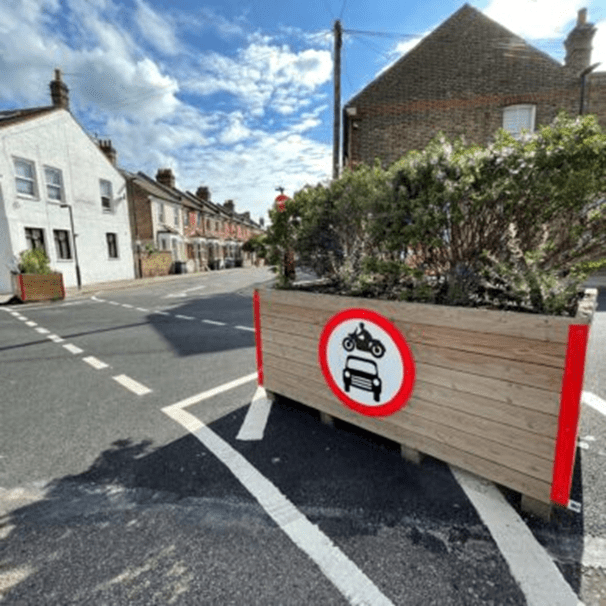
  • a proposal to introduce a rat running reduction scheme in the Lake House estate area.

And

  • a proposal to introduce a 20mph zone in the Wanstead area, covering the area south of the A12 and west of the A406 up to the Borough boundaries with Waltham Forest and Newham. 

You can find the details here:

Lake House Rat Running Reduction Proposal | Let’s Talk Redbridge

Wanstead Area Road Safety Zone | Let’s Talk Redbridge

The closing dates for the consultations are 5th June 2025.

These are road safety schemes – they are intended to reduce deaths and injuries caused by road traffic accidents – rather than schemes designed to promote cycling and walking.  But these schemes do effect cyclists and, if well designed, they can make cycling and walking more attractive options for more people.  What you are reading now are our views on the schemes from a cyclist’s point of view.  Other points of view are available.   …

We have had a first look at the proposals and there’s a lot to like.  This post sets out our first thoughts.  As we think about the schemes more it’s quite likely that we will refine our thoughts and want to add some further comments.  If we do, we will post an update on our website. 

So, if you haven’t already responded to the surveys you might want to hold off doing so until nearer to the closing date.  If you have already responded (well done) and you want to add anything in the light of what we have written, you can email your additional comments to traffic.schemes@redbridge.gov.uk. 

Please feel free to use any of our comments in your response.  

Before we look at the specific schemes in detail here are a few general remarks.

  1. The areas covered by the proposals are almost all residential and so a speed limit of 20 mph is entirely sensible. The arguments sometimes used against 20 mph zones (which we don’t buy) that slowing down traffic across entire areas can clog up roads, delay journeys and hit productivity, especially for trades people and small businesses, won’t apply. 
  2. There’s no doubt that cyclists and pedestrians will welcome slower speeds.  Cyclists will feel safer on the effected roads.  If a cyclist is in a collision with a motor vehicle going at 20 mph, they are less likely to be killed or seriously injured than if the vehicle is travelling at 30 mph. 
  3. Transport for London have just published the findings of an extensive study of more than 150 20mph schemes implemented during this period 1989 to 2013.  The study found:
  4. That introduction of 20mph schemes led to a 40 per cent reduction in fatalities, falling from 15 to just nine, compared to a background trend of seven per cent fewer deaths across all borough roads. 
  5. Child safety improved dramatically with a 75 per cent reduction in children killed and a 50 per cent reduction in child casualties.
  6. A 35 per cent reduction in collisions and a 36 per cent reduction in casualties on roads with 20mph limits. 

It’s really what you would expect. 

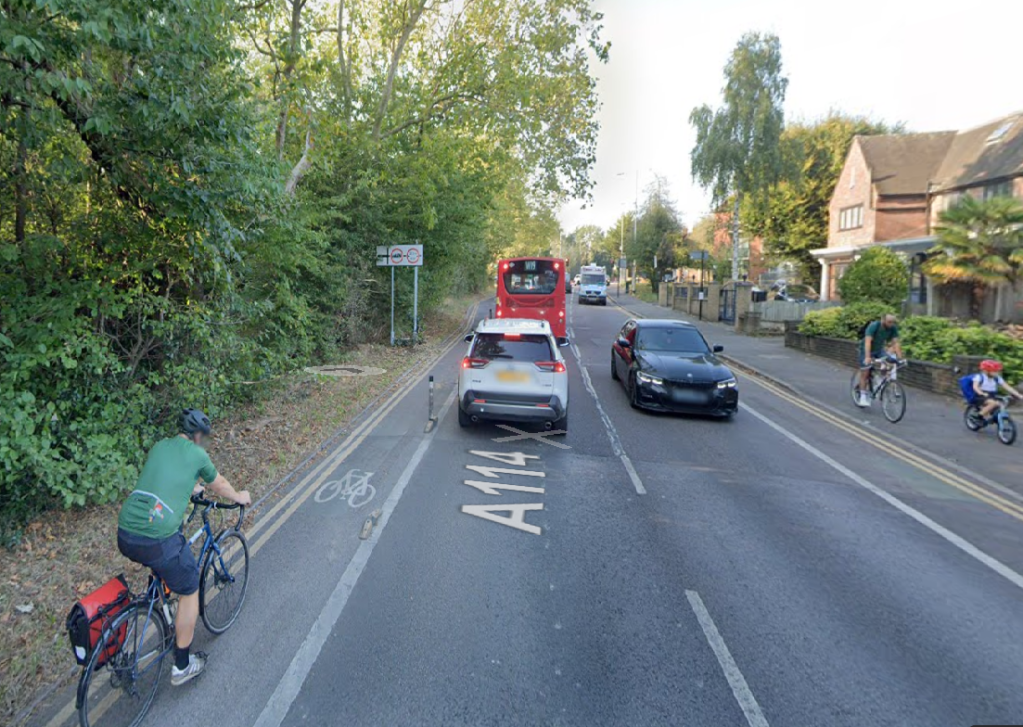
  • The seven pinch points at the traffic islands along Aldersbrook Road have long been a source of complaint amongst local cyclists.  The cycle tracks end at the traffic islands where motor vehicles must move in towards the kerb and into the path of cyclists.  Many a regular user of the cycle tracks will tell you how they have nearly been knocked off by cars swerving towards the kerb.  Redbridge Cycling Campaign and individual cyclists have lobbied council officers and local councillors to do something about them and so, the proposal to remove two of them is welcome.  But that still leaves five. 

We can understand the problems of removing the two islands with speed cameras on them but why not replace the other three with zebra crossings?  This would help pedestrians and it would make cyclists using the tracks along Aldersbrook Road feel safer.  Why is this important?  Because it is only when potential cyclists feel safe that they get on their bikes and become cyclists.  And current cyclists coming from the Manor Park direction (for example from the Railway Station) could also use the zebra crossings to exit from Aldersbrook Road into the turnings of the Aldersbrook Estate – now it’s a difficult manoeuvre.  So, we think more zebra crossings will be a win all round. 

  • We are pleased to see that the Council plans to instal sinusoidal speeds humps – these are the most comfortable design for cyclists. 

We will be supporting these schemes.  Could they be improved upon to support the Council’s ambitions to see more people on bikes?  Yes, and here’s how …

Lake House Rat Running Reduction Proposal

The proposal to introduce a No Entry Except for Access Restriction between 7 and 10am and 4 and 7pm is welcome but:

  • The success of last April’s Aldersbrook Bicibus event (parents and children riding to Aldersbrook School) proved that parents and children from the Lake House Estate want to get to school by bike.  The timed no entry restriction will help create quiet roads on the estate that will be suitable for these parents and children to cycle – especially in the morning.  If the afternoon timed restriction started at 2.30 or 3 pm then this would be better, removing the risk that parents and their children might meet early bird rat runners. 
  • It’s hard to see why the restriction is not permanent: if rat running isn’t a problem between 10 am and 4 pm there is no harm in the restriction being in place because hardly anyone is nipping through the estate – and those few shouldn’t be because the main roads are OK. 

Of course, the problem is that parents cycling from Lake House to Aldersbrook School then must cycle down Woodlands Avenue.  This is not a cycle friendly street, but we think that there is a solution – more on that below.

Wanstead Area Road Safety Zone (South-West Area)

Replacing the traffic island at the junction of Queenswood Gardens and Aldersbrook Road with a zebra crossing is a good idea.  It will provide better pedestrian access to the bus stop on the opposite side of the road, and we expect it will be welcomed by pedestrians. 

As we mentioned above, Woodlands Avenue, despite having (fierce) speeds humps is not cycle friendly.  With cars parked on either side of the road the effective carriageway is narrow and motor vehicles push past cyclists.  The Avenue is also a rat run: motor vehicles travelling in the direction of Wanstead use Park Road and Woodlands Avenue to avoid the mini roundabouts.  We think there is a solution: make Woodlands Road a school street with, in the hours of the school run, restricted access.  This would mean installing cameras at either end of the road facing onto Park Road and Blake Hall Road.  Motor vehicles trying to turn into Woodlands Avenue would be ticketed.  Because the cameras face outwards, residents driving out of Woodlands Avenue go undetected, so they are fine.  Residents can apply for an exemption so that they can drive into Woodlands Avenue during the restricted hours. 

Wanstead Area Road Safety Zone (South-East Area)

Once again, replacing the traffic island at the junction of Empress Avenue and Aldersbrook Road with a zebra crossing is a good idea.  It will help cyclists by removing one of the dangerous pinch points on Aldersbrook Road. 

Motor vehicles do speed along Wanstead Park Avenue and so speed reduction measures are appropriate. 

Wanstead Area Road Safety Zone (North Area)

There is a rat run through this area from the A12 along Redbridge Lane West, Langley Drive and Overton Road to Blake Hall Road.  The council, rightly, thinks the Lake House estate needs a rat running reduction scheme.  So surely the residents of this area deserve on too?  And, of course, Wanstead High School is on the rat run. 

St. Marys Avenue links Wanstead High Street to St. Mary’s Church and Wanstead Cricket, Golf and Tennis Clubs.  It should be a cycle friendly road – one you can cycle along with your children as they go to their cricket, golf or tennis lessons – or to church!  But it isn’t. 

Many motor vehicles can straddle the speed pillows and so can, and do, disregard the speed limit.  This puts off potential cyclists: parents will be driving their children to cricket etc. instead of cycling with them.  The position of the pillows in relation to the kerb means that motor vehicles swerving into cyclists’ line of travel.  If speed humps are right for all the other roads in the area, then surely, they are right for St Marys Avenue too.  So, we think the pillows should be replaced by humps. 

Can the scheme include improving the pedestrian crossing outside Wanstead House?

DIY Local Cycle Improvements

Here at RCC our engagement with the council tends to be:

  • Responding to consultations on proposed cycle infrastructure schemes and, if they affect cyclists, road safety traffic schemes.
  • Pushing for more and better cycling infrastructure.

It’s hard work but someone’s got to do it.  

But this is not the only way to get things done …Councils take seriously and respond to proposals put forward by groups of residents.  It’s all well and good for a London Borough Cycling Campaign to ask the Council to create an LTN or instal Anti Rat Run measures on the ‘Plagued by Through Traffic Estate’ to reduce through traffic, make crossings safer for children on their way to school and the streets generally more cycling and waking friendly (it would, wouldn’t it).  It’s another matter, though, if the residents of the Plagued by Through Traffic Estate ask for these things themselves.  And it’s even better if the residents can enlist the support of their local councillors, an important part of whose role is to represent the wishes of their constituents. 

Does any of this apply to Redbridge?  We think it might. We think we have come across a road safety scheme (a new crossing of a busy road) that was developed in response to local demand (a petition and lobbying of Councillors).  To their credit, council officers, when working up the scheme, saw and took the opportunity to incorporate some new and useful cycle infrastructure.

So, it might be that your street WhatsApp group, your school gate friends or your fellow football parents, think something should be done to make things better and safer for cycling and walking in your area.  If so, why not have a go at approaching the Council?  Officers and Councillors might well agree with you and the Councillors will certainly want your votes.  If you do decide to have a go and if there is anything we can do to help, we will.  For example, we might be able to tell you what other Councils in other parts of London have done in similar situations.

As ever we can be contacted by email and here’s the link to how run a petition
https://www.redbridge.gov.uk/about-the-council/petitions/

London Cycle Routes

A little while ago we came across this YouTube channel.  It’s informative and entertaining.

If you look at an A to B journey you are familiar with, we bet you will end up thinking I wouldn’t have gone that way, I would have gone down Smith Street instead of Jones Road, or that’s a way I hadn’t thought about – or both.

If you want to go from A to B, are wondering how to do it and Mr. London Cycle Routes has done it, then his route is a good place to start. 

Redbridge Cycle Campaign’s response to the London Borough of Redbridge’s consultation on its draft Sustainable Transport Strategy

What we like

Redbridge Cycling Campaign (RCC) is pleased that the Council has decided to draft and consult upon a Sustainable Transport Strategy. 

  • We agree with the Council’s assessment of the Borough’s its current transport network stands and with what will happen if the Council does not act. 
  • We agree with the proposed hierarchy of road users and with the Council’s intention to use it to rebalance street priorities. 
  • We agree with the Council’s plan to use the movement and place framework when planning for the future of its road and street network.  We think this has the potential to create streets that will allow residents to go about their daily lives on bicycle or foot. 

But …

We do not think that what the Council says that it is going to do and the targets that it is proposing to set are anywhere near ambitious enough.  As they stand, the actions and targets will not deliver what the Council says it wants to achieve and will not keep Redbridge moving.

The problem with journeys made by car that threatens to undermine the strategy’s aims.

On the face of it, the target of reducing car journeys from 47% to 33% of all journeys made by 2041 looks laudable.  However, this target needs to be seen in the context of an increasing population and so an increase in the total number of journeys made: more people mean more journeys.  When we do the sums, 33% of journeys made in 2041 may not be a hugely different number to 47% of journeys made in 2021. 

So even if the Council could achieve its target of reducing car journeys to 33% of all journeys, traffic volumes could still be such that the Borough’s road network will be at, or close, to full capacity (because it already is).  This will mean that all the current problems the Council describes in the introduction to its strategy (p8), and which it wants to address, will remain largely unsolved. 

There are also reasons to think that the Council’s approach to reducing the percentage of journeys made by car will fail.   Although the Council is proposing measures to reduce motor traffic speed it is not proposing measures to reduce motor traffic volumes or to stop drivers rat running along what should be quiet residential streets – a problem that is likely to get worse as navigation apps increasingly route drivers along residential roads to avoid junctions and traffic lights on more major roads. 

This is at odds with the Council’s stated intention to rebalance street priorities.  Rebalancing street priorities must include reducing traffic volumes on residential roads and this must mean introducing schemes to restrict motor traffic either by installing physical barriers or cameras. 

We think that the only way to stop Redbridge coming to a halt and for the Council to meet its ambitions is to place much more emphasis on wheeling, walking and cycling. 

The role of cycling in achieving the Council’s aims

We think the ambition to shift the percentage of journeys undertaken by cycle from 1% in 2021 to 3% in 2041 is woefully short of ambition.  The Council’s proposed cycle network included in its plan (p32) is simply inadequate: it lacks coherence and connectivity.  But if the Council only expands its cycle network as set out on pages 31 to 33 then just 3% of journeys being made by bike by 2041 may be all that we can hope for. 

On the other hand, if the Council is serious about rebalancing its street priorities using the proposed hierarchy of road users and a movement and place framework then there is every reason to think that travel by cycle should account for a much greater share of the journey’s residents make. 

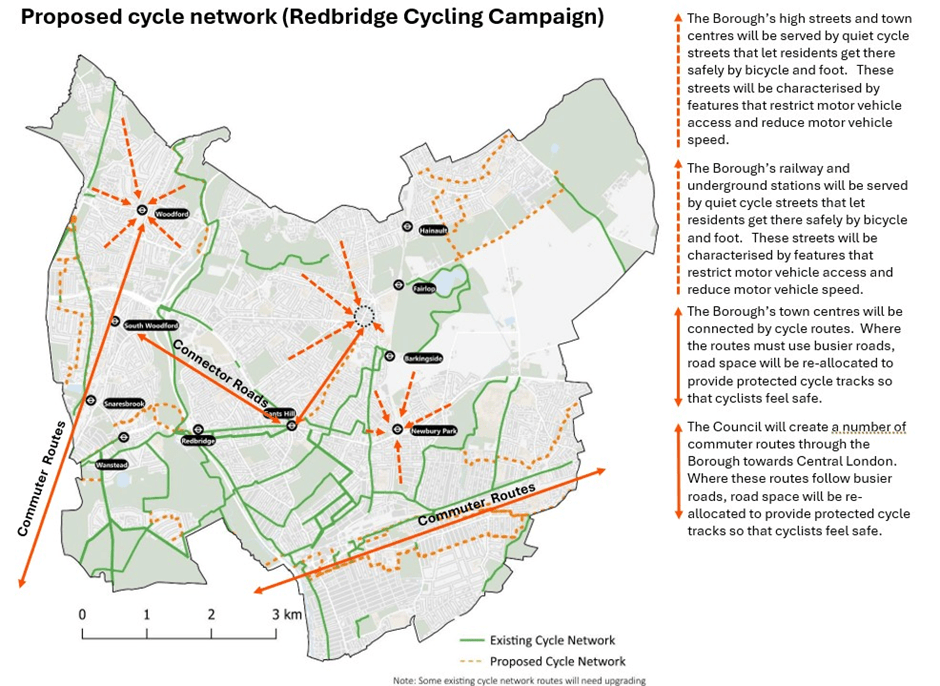
We think that to achieve its ambitions the council needs to replace the proposed cycle network (p32) and associated targets with an expanded network along these lines:

The proposed network should comprise:

  • Commuter routes through the borough towards Central London.  Where these routes follow busier roads, road space must be re-allocated to provide protected cycle tracks so that cyclists feel safe.
  • Routes connecting the borough’s town centres.  Where the routes must use busier roads, road space must be re-allocated to provide protected cycle tracks so that cyclists feel safe. 
  • Quiet cycle streets that let residents travel safely by bicycle and on foot to the borough’s railway and underground stations and schools.  These streets will be characterised by features that restrict motor vehicle access and reduce motor vehicle speed.  
  • Quiet cycle streets that let residents travel safely by bicycle and on foot to the Borough’s high streets and town centres. These streets will be characterised by features that restrict motor vehicle access and reduce motor vehicle speed. 

Only a network built along these lines – incorporating quiet streets, protected and segregated cycle tracks – will allow residents to choose cycling to a means go about their daily lives and see the required reduction in journeys by car. 

Risks to the successful implementation of any Sustainable Transport Strategy

We think that there are three significant risks to the successful implementation of the strategy that are within the control of the council. 

  • First is a lack of political will.  It is not enough for the relevant cabinet lead member to be committed to the strategy; the commitment must start at the top with the leader themselves.  Without the commitment of the leader of the Council it is likely that the plan will not be made a priority and so will not receive the resources that it needs. 
  • Next there is the risk that commitment to the plan is not communicated to officers and that councillors are too prepared to listen to reasons why things cannot be done. 
  • Finally, there is the risk that there are not enough officers employed to carry out the work and/or those that are employed lack the skills, knowledge and understanding needed to bring to life to concept of a network of cycle safe streets through well designed schemes and to be able to write bids to secure the funding the schemes need. 

If any or all these risks occur, then funding will go to other Boroughs and the strategy will fail. 

The last post

This is our last post.  The deadline for responding to the survey is the 5th January.  Here is the link to the survey

Sustainable Transport Strategy Survey | Let’s Talk Redbridge

You can also make a bespoke response by sending an email to sts@redbridge.gov.uk

This post sets out our thoughts on the 4 questions in the survey that allow free text answers.  If you plan to respond to the consultation using the survey form and you are inclined to agree with us, feel free to cut and paste – but change we to I. 

Redbridge Cycling Campaign and London Cycling Campaign will both submit bespoke responses. 

So, here’s what we think …

To date the borough has made very limited and disjointed provision for cyclists.  Almost every journey involves passing through difficult junctions and cycling along roads without the required degree of protection.  Close passing, being chased down between speed humps, cars parked in cycle lanes and speeding vehicles are features of almost every journey. 

The council’s assessment of what will happen to traffic if it does nothing looks sound and realistic.  Doing nothing is not an option.  We agree that street priorities need rebalancing.  We agree that the best way to rebalance priorities is by analysing the borough’s road network using the proposed movement and place framework and the hierarchy of road users.  This should provide a clear picture of what needs to be done.

We think that there are three significant risks to the successful implementation of the strategy that are within the control of the council.  First is a lack of political will.  It is not enough for the relevant cabinet lead member to be committed to the strategy; the commitment must start at the top with the leader themselves.  Without the commitment of the leader of the Council it is very likely that the plan will not be made a priority and so will not receive the resources that it needs.  Next there is the risk that commitment to the plan is not communicated to officers and that councillors are too prepared to listen to reasons why things can be done.  Finally, there is the risk that there are not enough officers employed to carry out the work and/or those that are employed lack the skills, knowledge and understanding needed to bring to life to concept of a network of cycle safe streets through well designed schemes and to be able to write bids to secure the funding the schemes need.  If any or all of these risks occur, then funding will go to other Boroughs and the strategy will fail. 

We have no comments to make here. 

The Sustainable Transport Strategy has plenty of excellent stated ambitions, but the detailed plans aren’t anywhere near bold enough to achieve them.  The proposed cycle network included in the plan is simply inadequate: it lacks coherence and connectivity.  The proposed network should comprise

  1. Commuter routes through the borough towards Central London.  Where these routes follow busier roads, road space must be re-allocated to provide protected cycle tracks so that cyclists feel safe
  2. Routes connecting the borough’s town centres.  Where the routes must use busier roads, road space must be re-allocated to provide protected cycle tracks so that cyclists feel safe. 
  3. Quiet cycle streets that let residents travel safely by bicycle and on foot to the borough’s railway and underground stations and schools.  These streets will be characterised by features that restrict motor vehicle access and reduce motor vehicle speed.  
  4. Quiet cycle streets that let residents travel safely by bicycle and on foot to the Borough’s high streets and town centres. These streets will be characterised by features that restrict motor vehicle access and reduce motor vehicle speed. 

For reference an indicative map showing such a network can be found in a post on the Redbridge Cycling Campaign website in a post headed ‘To boldly go ‘ dated 5th December