Imagine all the traffic moving in harmony…

Let’s imagine it’s 2032 and that Redbridge’s Sustainable Transport Strategy is a success.  What might a newspaper article reporting the success say? 
The Ilford Courier

1st April 2032

By Mikael Moreno

On yer bike, Redbridge’s Sustainable Transport Strategy has a tailwind behind it. 

Following a consultation Redbridge Council launched its Sustainable Transport Strategy (STS) in early 2025.  The premise was hard-headed: unless something was done, by 2041 if not sooner, Redbridge would grind to a halt.  Now, in 2032, the strategy is on course and Redbridge is still moving, so how and why has Redbridge made such good progress?

During the 2024 consultation many of those responding highlighted what they saw as the mismatch between what Redbridge said it wanted to achieve and what it planned to do.  

By 2028 Redbridge wasn’t seeing the hoped for switch to cycling and walking.  Neither traffic volumes nor traffic speeds were reducing, and residents were telling the Council that they still did not feel confident cycling around the Borough.  The Council also identified two new problems.  More and more SUVs could negotiate speed humps at speeds close to 30mph, rendering the humps ineffective, and navigation apps were routing drivers along unsuitable residential roads to avoid junctions and traffic lights on more major roads.  If anything, the traffic situation was getting worse rather than better.  

At the same time, hopes were fading that residents would choose to use buses rather than their cars, not least because the buses were stuck in traffic and the road network couldn’t accommodate more, new, bus lanes. And the rail and tube networks were running at full capacity and extending these networks was beyond anything the Council could do.

So, what to do?  Brompton Verdi, the Cabinet Member for Transport told me, ‘We realised that creating a shift to cycling was the only way to stop Redbridge coming to a halt and that we need to change our strategy if we were going to achieve this’  The council decided to put more emphasis on creating the conditions residents needed if they were to get on their bikes.  Verdi went on to tell me ‘We prioritized routes into our town centres, schools and the like, because this is where we felt we could have the biggest and quickest impact and because it built on our successful Schools Streets programme’.  And because Redbridge is a compact Borough, separate routes to two adjacent town centres could often be combined to form a route connecting the town centres.  ‘We knew that most of these routes could not be along segregated or protected cycle tracks and that cyclists would need to use the carriageway.  So, the carriageway needed to be made safe for them to do this’, Verdi said. The Council started to introduce road closures, either by putting in physical barriers through which bicycles but not motor vehicles could pass (modal filters) or by using. cameras.  Of course, by 2028 this was not rocket science, plenty of London boroughs had already done this quite successfully. 

Verdi told me that ‘we went about this in a planned and not an ad hoc way.  ‘We asked our Highways staff to install the closures necessary to allow residents to get into our town centres, stations, schools and leisure facilities along safe quiet cycling routes.  We told them that they were not to leave gaps in the routes because it was too difficult – which usually meant Highways thought car drivers would be put to too much inconvenience.  We reminded Highways staff that the council was committed to reallocating road space in favour of cyclists as a precursor of encouraging more cycling and that they had to find solutions.  We knew that very few of our Highways staff were cyclists and that this was a weakness.  To compensate we told Highways that they were to involve local cycling groups and bicycle riding residents at an early stage in the design work to make sure we got it right.   And 9 times out of 10 they did’.

‘What we did wasn’t always popular with everyone – especially in the beginning – but opposition often seemed to evaporate, and we felt we had a mandate to proceed – we had consulted widely on the strategy and the Council had a large majority.  If residents hadn’t liked what we are doing, they could have voted us out’. 

As the Council rolled out its cycling streets it saw journeys made by bicycle start to increase. ‘This gave us the confidence to continue and to be more ambitious – it was clear to us that there were plenty of residents who were happy to cycle if the conditions were right.  The Council also noticed that residents of the areas covered by quiet cycling streets started to report feeling safer’.

When the Council investigated it found that the presence of cyclists made the streets feel less empty and deserted.  It turned out that those engaged in street crime and antisocial behaviour were more bothered by being happened upon by a cyclist than being passed by a car driver.  So this helped the Council make progress towards another of its targets which was to making its streets safer for female residents.  

Success breeds success.  The success of the cycling streets meant the Council was able to bid successfully for more and bigger schemes. 

Let’s give the last word to Brompton Verdi. ‘We were right to change tack in 2028 and to focus on cycling.  And I think those who said we weren’t trying to do enough were right.  We’re now well on the way to meeting the aspirations we set out in our Draft Strategy and, in 2032, Redbridge is still moving. 

Sustainable Transport Strategy

7 Up – statements we’re pleased to see

Before we get to the list this is what you can read on page 10:

We’re on the road to nowhere …

And now the statements …

1. This growth [in population from 310,100 (2021) to 365,000 (2041)] will not be possible without an integrated and sustainable transport network that allows everyone to travel from home to school, work and other key destinations across the borough and beyond, to keep Redbridge moving.  (p6). All else being equal, more people means more car journeys means Redbridge grinds to a halt.  Somethings gotta give, on yer bike – it takes up less road space. 

2. Public transport (e.g. bus, underground and rail) and active travel (walking, wheeling, cycling and scooting) networks are fragmented … and not well connected to green spaces or other key infrastructure in the borough such as transport links and places of work (p8). An honest assessment of where we are. Now’s the time for some joined up thinking.

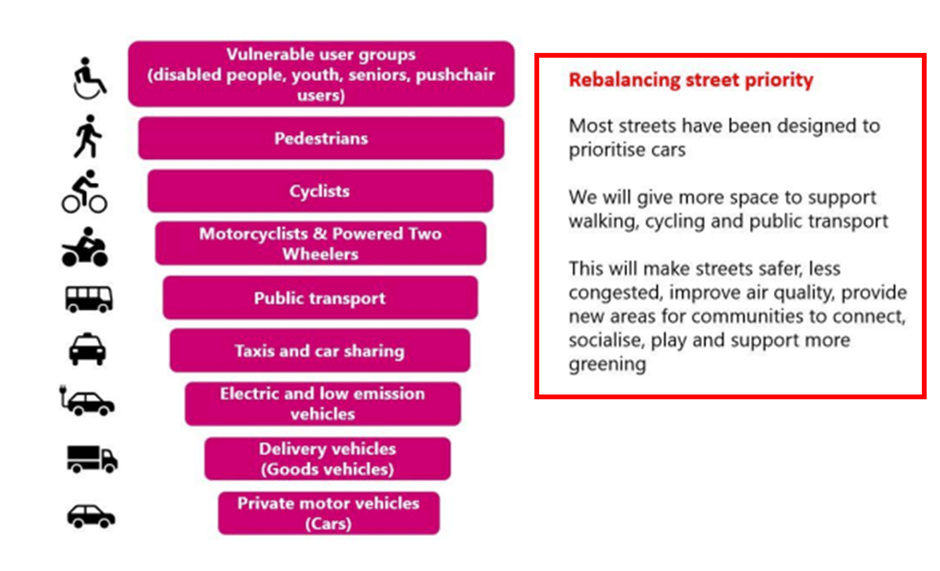
3. Road user hierarchy for Redbridge

As night follows day, we can’t build more roads for more cars so to keep Redbridge moving we need more people to walk, cycle and take the bus. These are not virtual activities: space is required and there is only one place to find it. 

4. To keep Redbridge moving the option to choose and use sustainable travel options that involve walking, wheeling, cycling and use of public transport is needed (p15).  That’s sorting out dangerous junctions, putting cycle tracks along main roads, reducing traffic speeds and turning rat runs into quiet streets.  17 years is enough time. 

5. The transport network will enable people to access key destinations, community services and green spaces by sustainable travel options, (p17).  As above.

6. The figure provides an insight into how different neighbourhoods, centres and roads should be characterised to keep Redbridge moving and importantly rebalance street priority to ensure vulnerable user groups pedestrians and cyclists feel safe

By our reckoning that’s most of the Borough’s Road network suitable for cycling which means, Borough wide, sorting out dangerous junctions, putting cycle tracks along main roads, reducing traffic speeds and turning rat runs into quiet streets.  There’s a bit of a theme emerging here …

7. At least 2/3 of all journeys will be by public transport, walking, wheeling (i.e. using of (sic) wheelchairs and mobility scooters), cycling or scooting.  (p7).  Surely a typo?  If Redbridge does what it says it wants to do, by 2041 4/5ths is possible isn’t it?  

School Streets Need Cycle Streets

RCC has enthusiastically supported all the council’s previous school streets proposals, and we are supporting this next set of proposals too. For the first time Redbridge are proposing to create school streets at secondary schools. This is a logical development, but it does throw up a new problem.  

Here’s the link to the consultations.

Redbridge says that:

‘School Streets aim to reduce levels of air pollution around our schools, making the air children breathe cleaner. They protect children from traffic hazards at the school gate, preventing accidents and keeping children safe. Students are also encouraged to walk and cycle to school, improving health and fitness’.

When it comes to secondary schools it’s the last aim that’s the problem.

No doubt many of those dropped off by car could easily walk to school but secondary schools do have much larger catchment areas than primary schools so some pupils who, at the moment are dropped off, would face a long walk to school. This is unlikely at a primary school. Of course, pupils can swap their parents’ car for a bike but only if the School Street scheme is complemented by the Council creating safe cycle routes to the school from all corners of the catchment area. This is do-able.

I have looked one of the schemes at a secondary school that I familiar with and, from the outer reaches of the catchment area, cycling to school instead of going by car is not an option.  There just aren’t routes that parents will consider safe for their children to ride. So, to the extent that all secondary school schemes suffer the same problem, the shift to active travel will be limited. More likely what will happen is that the drop off points move. 

If you think School Streets are a good idea support the schemes – so your response goes in the ‘yes’ pile – but in your response say that, to fully achieve its aims the council must introduce cycle routes (cycle streets as they are called in Germany) and traffic reduction measures across the catchment area to make cycling to school a safe and realistic choice.

The closing date for these consultations is 21st October 2024. 

Ilford to Gants Hill Road Safety and Cycling Improvements

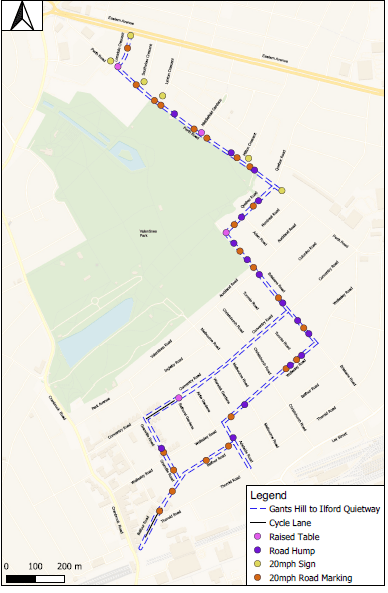
The proposed scheme is intended to establish a ‘quiet route’ for cyclists between Gants Hill and Ilford. 

You can read the full details and respond to the survey here:

Ilford to Gants Hill Road Safety and Cycling Improvements | Let’s Talk Redbridge

Make sure to have a look at the high level design.  Except for two short stretches of Balfour Road and Coventry Road, which will have mandatory cycles lanes, all the roads along the route will be for mixed traffic – which means there is no ‘protected space for cycling’ in the form of separate tracks or tracks in the road with wands etc. 

Local Transport Note 1/20 (LTN1/20), the Department for Transport’s current guidance on cycle infrastructure design states that

7.1.1 Where motor traffic flows are light and speeds are low, cyclists are likely to be able to cycle on-carriageway in mixed traffic.

This does not describe Perth Road, either now or as it will be if this scheme goes ahead as proposed.  This is because what the Council is proposing are exclusively speed management measures.  Traffic will travel more slowly but there is no reason to think that  will reduce. 

Traffic flows along Perth Road, which is most of the route – are not light: it is a busy road.  The Council has not provided any data on Motor Traffic Flow but Google Maps shows Perth Road as very busy and this is borne out by the experience of RCC members who have cycled along the road several times in the last few weeks: the volume of traffic means it is not a road we would recommend to cyclists. 

LTN 1/20 offers guidance on the appropriate level of protection from motor traffic by speed and traffic volume:

Unless the traffic flow along the Perth Road is less than 2000 vehicles per day – and we don’t think it is and don’t think it will be – the Council either needs to:

  1. Build protected space for cycling in one of the forms provided in LTN 1/20

or

  • Introduce traffic management (as opposed to speed management) measures to reduce traffic flows to the level where mixed traffic is acceptable. 

The scheme the Council is proposing does neither of these things. 

Reducing traffic flows would mean locating modal filters (planters in the road) and point no entries on Perth Road and any other adjacent roads that may otherwise turn into rat-runs, to push through-traffic onto the A12, Ley Street and Cranbrook Road.  This is not rocket science and there are numerous examples of such schemes both in London and elsewhere. 

Perth Road is not and, if the Council go ahead with the scheme, will still not be suitable for mixed traffic and so RCC does not support the scheme.  We think the Council need to go back to the drawing board.  Perth Road could be a useful cycling route but only if one of the options we set out above is taken up.  

If the Council can show us data that demonstrates that, if the scheme is implemented, Motor Traffic Flow on Perth Road will be down to 2000 per day – making it suitable for mixed traffic – we will revise our position. 

As ever, if you have time please do respond to the consultation.  You may not agree with our position and think that, whatever its shortcomings, it deserves support.  That’s fine  with us.  On the other hand if you agree with us feel free borrow or cut and paste some or all of what we have to say.  Or you can just say I agree with the comments made by Redbridge Cycling Campaign. 

If you do respond to the effect that you do not support the scheme as proposed please make sure that you do ask the Council to take it back to the drawing board because Perth Road could be made into a valuable cycle route.