Redbridge Cycling Campaign is going to launch a Dr. Bike scheme. Here’s the plan …
We want to run Fix your Bike sessions one Saturday or Sunday a month. At the sessions we will:
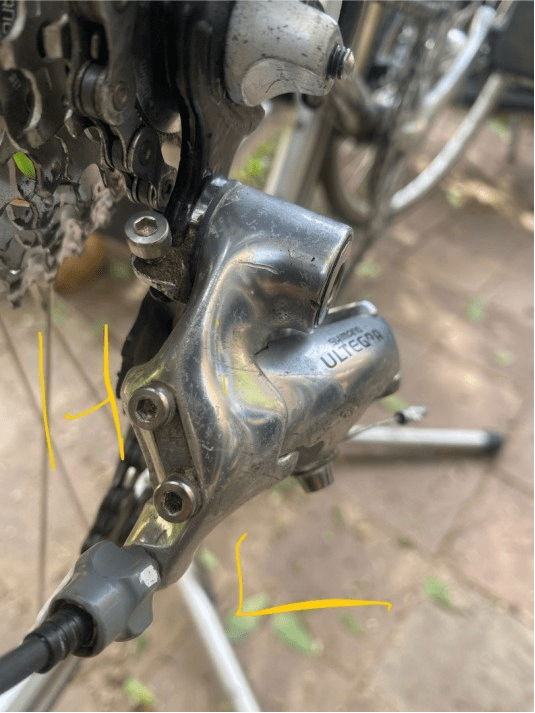
check bikes for roadworthiness.
make small adjustments to bikes.
carry out small repairs.
advise on more major repairs.
the aim of the scheme is to get customers’ bikes going again.
The session will last for three hours, probably between 11.00 am and 2.00 pm.
To run the sessions, we will need a pool of volunteers. We already have a few but the more the merrier. Volunteers will be needed for half an hour before and after a session to set up and break down the stall.
For each session we will need:
At least one person front of house.
At least one senior mechanic capable of carrying out the full range of repairs we offer.
One or two other mechanics who can carry out the repairs listed in the ‘required’ column below.
The roles can be split between two people. So, for example, if you could do front of house only between 10.30 am and 12.30 pm, we will try and pair you up with someone who can do 12.30 pm to 2.30 pm.
We hope we can create a pool of volunteers from which we can staff each session
Role
Description
Need to be able …
Nice to be able to ..
Very Nice to be able to …
Front of House
Help set up the stall. Receive bikes for repair. Record the customer’s phone number, bike type, and the repair requested. If necessary, check with the senior mechanic that the repair is possible. Issue a repair ticket and Place and secure the bike in the cycle rack. Contact the customer when the bike is ready for collection. Return the bike to the customer. Accept any donations the customer makes. Hand out RCC business cards and any material relating to current RCC campaigns. Talk to customers to find out about current cycling issues in the area. At the end of a session money Help break down the stall.
Use a Sum-up card (training can be provided). Chat to customers to get information on their cycling issues.
Come to our once monthly meetings to tell us what cycling issues customers have raised.
Mechanic
Carry out repairs to customers bikes according to the mechanics’ level of competence. Be responsible for a toolkit. If a tool gets lost, to let the lead mechanic know.
Lubricate a chain. Replace brake and gear cables. Replace brake and gear cable outers. Change an Inner tube. Adjust rim brakes. Replace brake blocks.
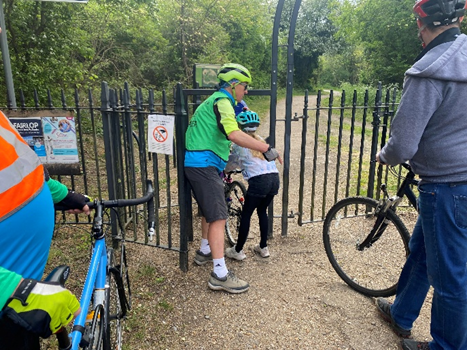
In June 2024 the Council took the decision to partially remove the cycle barriers at the entrances to Claybury Park on Roding Lane and Acle Close. That got a Hooray from RCC. The decision meant that more (but not all) cycles could get access to the park and could use the cycle track through the park. As you can see the track is recorded as part of the Borough’s existing cycle network (see below).
Well, the improved access didn’t’ last long …
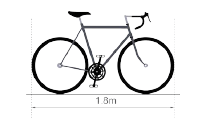
The Council has now re-instated the barriers, effectively restricting access to just those cyclists who ride one of these (straight handlebars/gravel bike bars allowed if they are not too wide).
We are not best pleased …
We have made a freedom of information request to the council to find out what is behind the decision. Once we receive a reply, we will take the matter up with the relevant person(s). At that point we may also ask for your help by writing to councillors or by signing a petition.
Here’s the text:
In June 2024 the Council took the decision to partially remove the cycle barriers at the entrances to Claybury Park on Roding Lane and Acle Close. The Council has now reversed this decision, re-instating the barriers.
Local Transport Note 1/20 paragraph 1.4.2 defines a cycle as follows:
‘For the purpose of this document, the term cycle refers to the full range of vehicles shown in Figure 5.2 in Chapter 5 and described in the accompanying text, including hand-cranked cycles and cycles that conform to the Electrically Assisted Pedal Cycle Regulations 1983 (as amended)’.
The council’s decision to re-instate the cycle barriers means that most types of cycles, as defined in LTN 1/20, will no longer be able to gain access to the park or only with considerable difficulty. Those adversely affected by this decision include those riding
cycles with child seats (parents and children),
cycles with tag-along trailers (parents and children)
cycles with buggies (parents and children)
hand powered cycles (people with disabilities)
tricycles (people with issues balancing, for example people who have suffered strokes or who have multiple sclerosis)
tandems (where the rear rider for some reason is unable to ride a solo bike)
Under the Freedom of Information Act and in relation to the Council’s decision to re-instate the cycle barriers at the gates to Claybury Park on Acle Close and Roding Lane I request the following information.
The position of the officer(s) or councillor(s) who took the decision to reinstate the cycle barriers.
A copy of any summary report or report setting out the case for re-instating the cycle barriers considered by those who took the decision.
What criteria were used to assess the impact of the partial removal of the cycle barriers? If none please say so.
If criteria were used, please provide the document containing the assessment against these criteria of the impact of partially removing the cycle barriers .
The minutes or notes of any meetings held to consider reinstating the cycle barriers. If none please say so.
The total number of instances of anti-social behaviour in Claybury Park reported to the Council in the period 1st June 2024 to 31st January 2025.
The number of instances of anti-social behaviour in Claybury Park reported to the Council involving cyclists in the period 1st June 2024 to 31st January 2025.
The number of instances of anti-social behaviour in Claybury Park reported to the Council involving motor cyclists in the period 1st June 2024 to 31st January 2025.
For the period 1st June 2024 to 31st January 2025, any documents, emails or other communications that refer to any proposals or actions that council officers or others considered taking or took to reduce anti-social behaviour in the park prior to the decision to re-instate the cycle barriers. If none please say so.
All data collected by Council Officers or others that was considered by those making the decision. If none please say so.
A copy of any access audit carried out by council officers or others or the findings from an Equalities Impact Assessment on the impact of a decision to reinstate the cycle barriers on those cyclists who would no longer be able to access the park or only with considerable difficulty and in particular cyclists with disabilities. If no access audit or Equalities Impact Assessment was carried out, please say so.
For the period 1st June 2024 to 31st January 2025, all emails or documents written by council officers, council members or others that discuss or refer to the implications of re-instating the cycle barriers on those who ride cycles that will no longer be able to access the park or only with considerable difficulty.
Redbridge Cycling Campaign (RCC) is pleased that the Council has decided to draft and consult upon a Sustainable Transport Strategy.
We agree with the Council’s assessment of the Borough’s its current transport network stands and with what will happen if the Council does not act.
We agree with the proposed hierarchy of road users and with the Council’s intention to use it to rebalance street priorities.
We agree with the Council’s plan to use the movement and place framework when planning for the future of its road and street network. We think this has the potential to create streets that will allow residents to go about their daily lives on bicycle or foot.
But …
We do not think that what the Council says that it is going to do and the targets that it is proposing to set are anywhere near ambitious enough. As they stand, the actions and targets will not deliver what the Council says it wants to achieve and will not keep Redbridge moving.
The problem with journeys made by car that threatens to undermine the strategy’s aims.
On the face of it, the target of reducing car journeys from 47% to 33% of all journeys made by 2041 looks laudable. However, this target needs to be seen in the context of an increasing population and so an increase in the total number of journeys made: more people mean more journeys. When we do the sums, 33% of journeys made in 2041 may not be a hugely different number to 47% of journeys made in 2021.
So even if the Council could achieve its target of reducing car journeys to 33% of all journeys, traffic volumes could still be such that the Borough’s road network will be at, or close, to full capacity (because it already is). This will mean that all the current problems the Council describes in the introduction to its strategy (p8), and which it wants to address, will remain largely unsolved.
There are also reasons to think that the Council’s approach to reducing the percentage of journeys made by car will fail. Although the Council is proposing measures to reduce motor traffic speed it is not proposing measures to reduce motor traffic volumes or to stop drivers rat running along what should be quiet residential streets – a problem that is likely to get worse as navigation apps increasingly route drivers along residential roads to avoid junctions and traffic lights on more major roads.
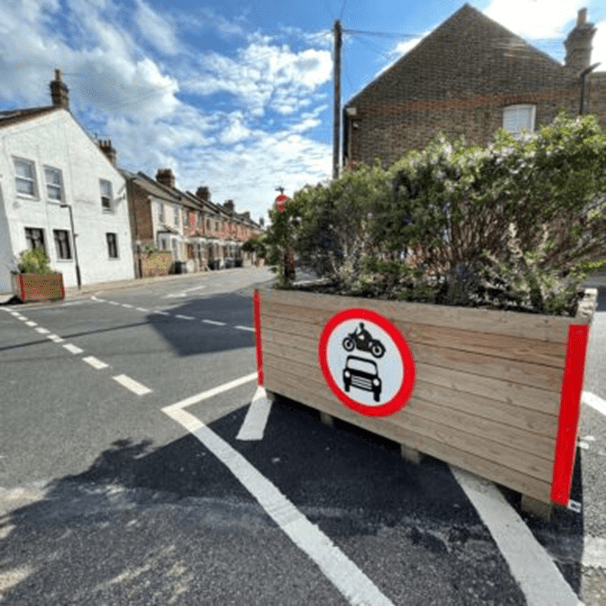
This is at odds with the Council’s stated intention to rebalance street priorities. Rebalancing street priorities must include reducing traffic volumes on residential roads and this must mean introducing schemes to restrict motor traffic either by installing physical barriers or cameras.
We think that the only way to stop Redbridge coming to a halt and for the Council to meet its ambitions is to place much more emphasis on wheeling, walking and cycling.
The role of cycling in achieving the Council’s aims
We think the ambition to shift the percentage of journeys undertaken by cycle from 1% in 2021 to 3% in 2041 is woefully short of ambition. The Council’s proposed cycle network included in its plan (p32) is simply inadequate: it lacks coherence and connectivity. But if the Council only expands its cycle network as set out on pages 31 to 33 then just 3% of journeys being made by bike by 2041 may be all that we can hope for.
On the other hand, if the Council is serious about rebalancing its street priorities using the proposed hierarchy of road users and a movement and place framework then there is every reason to think that travel by cycle should account for a much greater share of the journey’s residents make.
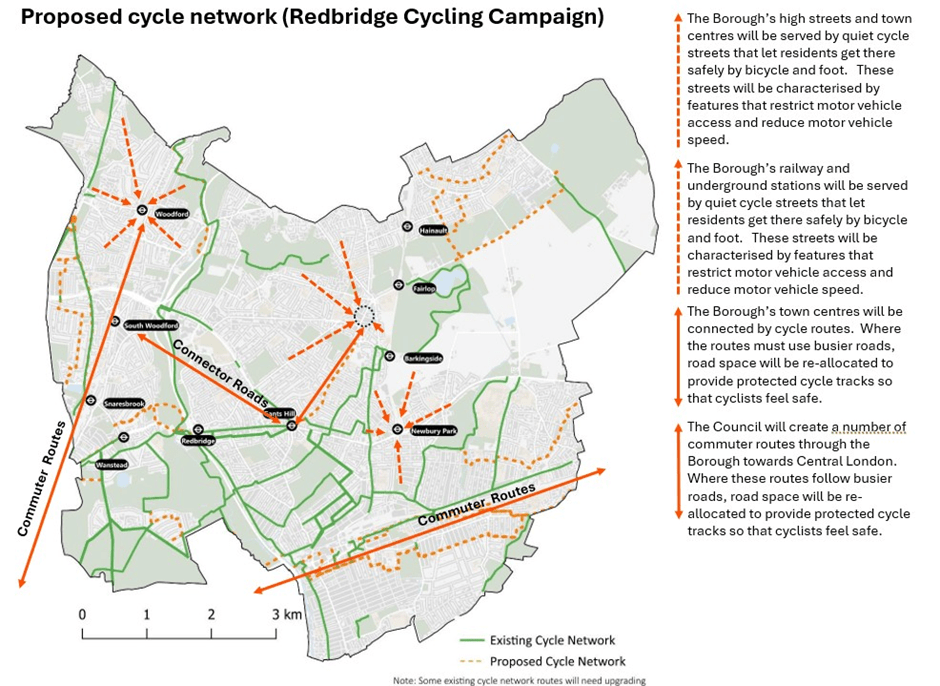
We think that to achieve its ambitions the council needs to replace the proposed cycle network (p32) and associated targets with an expanded network along these lines:
The proposed network should comprise:
Commuter routes through the borough towards Central London. Where these routes follow busier roads, road space must be re-allocated to provide protected cycle tracks so that cyclists feel safe.
Routes connecting the borough’s town centres. Where the routes must use busier roads, road space must be re-allocated to provide protected cycle tracks so that cyclists feel safe.
Quiet cycle streets that let residents travel safely by bicycle and on foot to the borough’s railway and underground stations and schools. These streets will be characterised by features that restrict motor vehicle access and reduce motor vehicle speed.
Quiet cycle streets that let residents travel safely by bicycle and on foot to the Borough’s high streets and town centres. These streets will be characterised by features that restrict motor vehicle access and reduce motor vehicle speed.
Only a network built along these lines – incorporating quiet streets, protected and segregated cycle tracks – will allow residents to choose cycling to a means go about their daily lives and see the required reduction in journeys by car.
Risks to the successful implementation of any Sustainable Transport Strategy
We think that there are three significant risks to the successful implementation of the strategy that are within the control of the council.
First is a lack of political will. It is not enough for the relevant cabinet lead member to be committed to the strategy; the commitment must start at the top with the leader themselves. Without the commitment of the leader of the Council it is likely that the plan will not be made a priority and so will not receive the resources that it needs.
Next there is the risk that commitment to the plan is not communicated to officers and that councillors are too prepared to listen to reasons why things cannot be done.
Finally, there is the risk that there are not enough officers employed to carry out the work and/or those that are employed lack the skills, knowledge and understanding needed to bring to life to concept of a network of cycle safe streets through well designed schemes and to be able to write bids to secure the funding the schemes need.
If any or all these risks occur, then funding will go to other Boroughs and the strategy will fail.
You can also make a bespoke response by sending an email to sts@redbridge.gov.uk
This post sets out our thoughts on the 4 questions in the survey that allow free text answers. If you plan to respond to the consultation using the survey form and you are inclined to agree with us, feel free to cut and paste – but change we to I.
Redbridge Cycling Campaign and London Cycling Campaign will both submit bespoke responses.
So, here’s what we think …
7. Please tell us about any other things you face frequently on your journeys in or through the borough that you wish to tell us about.
Please also remember to use the map at the bottom of the main page to pinpoint specific things to us.
To date the borough has made very limited and disjointed provision for cyclists. Almost every journey involves passing through difficult junctions and cycling along roads without the required degree of protection. Close passing, being chased down between speed humps, cars parked in cycle lanes and speeding vehicles are features of almost every journey.
11. Please tell us about any your thoughts on the potential challenges and priorities of the Sustainable Transport Strategy that you wish to tell us about.
The council’s assessment of what will happen to traffic if it does nothing looks sound and realistic. Doing nothing is not an option. We agree that street priorities need rebalancing. We agree that the best way to rebalance priorities is by analysing the borough’s road network using the proposed movement and place framework and the hierarchy of road users. This should provide a clear picture of what needs to be done.
We think that there are three significant risks to the successful implementation of the strategy that are within the control of the council. First is a lack of political will. It is not enough for the relevant cabinet lead member to be committed to the strategy; the commitment must start at the top with the leader themselves. Without the commitment of the leader of the Council it is very likely that the plan will not be made a priority and so will not receive the resources that it needs. Next there is the risk that commitment to the plan is not communicated to officers and that councillors are too prepared to listen to reasons why things can be done. Finally, there is the risk that there are not enough officers employed to carry out the work and/or those that are employed lack the skills, knowledge and understanding needed to bring to life to concept of a network of cycle safe streets through well designed schemes and to be able to write bids to secure the funding the schemes need. If any or all of these risks occur, then funding will go to other Boroughs and the strategy will fail.
16. Please explain why, if any of the key goals do not meet your needs or if you want to tell us about any other actions you want us to include?
Please also see our long list of actions for the strategy that provide a more comprehensive list of actions per theme, see link.
We have no comments to make here.
17. Do you have any other comments about the draft Sustainable Transport Strategy?
The Sustainable Transport Strategy has plenty of excellent stated ambitions, but the detailed plans aren’t anywhere near bold enough to achieve them. The proposed cycle network included in the plan is simply inadequate: it lacks coherence and connectivity. The proposed network should comprise
Commuter routes through the borough towards Central London. Where these routes follow busier roads, road space must be re-allocated to provide protected cycle tracks so that cyclists feel safe
Routes connecting the borough’s town centres. Where the routes must use busier roads, road space must be re-allocated to provide protected cycle tracks so that cyclists feel safe.
Quiet cycle streets that let residents travel safely by bicycle and on foot to the borough’s railway and underground stations and schools. These streets will be characterised by features that restrict motor vehicle access and reduce motor vehicle speed.
Quiet cycle streets that let residents travel safely by bicycle and on foot to the Borough’s high streets and town centres. These streets will be characterised by features that restrict motor vehicle access and reduce motor vehicle speed.
For reference an indicative map showing such a network can be found in a post on the Redbridge Cycling Campaign website in a post headed ‘To boldly go ‘ dated 5th December




 Redbridge Cycling Campaign