Here at RCC our engagement with the council tends to be:
Responding to consultations on proposed cycle infrastructure schemes and, if they affect cyclists, road safety traffic schemes.
Pushing for more and better cycling infrastructure.
It’s hard work but someone’s got to do it.
But this is not the only way to get things done …Councils take seriously and respond to proposals put forward by groups of residents. It’s all well and good for a London Borough Cycling Campaign to ask the Council to create an LTN or instal Anti Rat Run measures on the ‘Plagued by Through Traffic Estate’ to reduce through traffic, make crossings safer for children on their way to school and the streets generally more cycling and waking friendly (it would, wouldn’t it). It’s another matter, though, if the residents of the Plagued by Through Traffic Estate ask for these things themselves. And it’s even better if the residents can enlist the support of their local councillors, an important part of whose role is to represent the wishes of their constituents.
Does any of this apply to Redbridge? We think it might. We think we have come across a road safety scheme (a new crossing of a busy road) that was developed in response to local demand (a petition and lobbying of Councillors). To their credit, council officers, when working up the scheme, saw and took the opportunity to incorporate some new and useful cycle infrastructure.
So, it might be that your street WhatsApp group, your school gate friends or your fellow football parents, think something should be done to make things better and safer for cycling and walking in your area. If so, why not have a go at approaching the Council? Officers and Councillors might well agree with you and the Councillors will certainly want your votes. If you do decide to have a go and if there is anything we can do to help, we will. For example, we might be able to tell you what other Councils in other parts of London have done in similar situations.
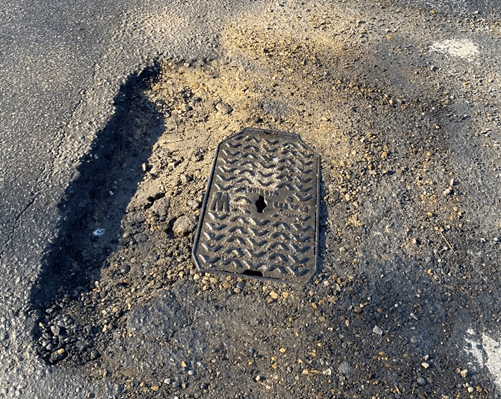
Everyone who cycles comes across things they want fixed on the road. Often, they are bits of road surface that wouldn’t bother motorists, either because they don’t feel them because of their suspension, or because they are on a part of the road where they tend to affect cyclists more. So, what can you do about it? (Other than waiting for the whole stretch of road to be resurfaced.) The simple answer is that you report it to the Council. There are two ways. You can either use the council’s own web site, or do it via an app.
From the options menu, click on ‘Streets and Highways’. (You will also see a button for reporting it via the Love Clean Streets app, but we’ll come back to that.)
The page you get to has three boxes, each with a menu of choices. The one you want will probably be ‘Problem on the road’. You can only choose from the given options, and in most cases that will probably be ‘Pothole’. But that isn’t ideal if what you want to report doesn’t really fit that category – for example, a badly filled trench acting like an unofficial and really harsh speed hump.
If you select ‘Pothole’, you’ll then go to a page where you can locate the problem by putting in an address, letting the site automatically detect your location, or marking the location on a map. Once you’ve done this, you can provide additional information on the issue, for example the size and depth of the pothole. You can also upload pictures. Then you fill in your details and submit the report. I’ve used this system to get a road surface problem fixed and it worked, although it did feel like I was having to take something designed to report specific issues, and make it do something it wasn’t designed to do. So, let’s look at the alternative.
If you go back to the ‘Report It’ page, at the bottom right of the options you’ll see a box with ‘Report it on the Love Clean Streets app’. Redbridge are one of only a handful of London councils that don’t use the app FixMyStreet (https://www.fixmystreet.com/). Why? No idea. But it seems that recently Redbridge has adopted lovecleanstreets: https://lovecleanstreets.info/.
If you select this option, you’ll go to a screen where you can download the app, set Redbridge as the home authority, then take a photo, pick the category it comes under, and submit the report. There’s more about how it works on https://lovecleanstreets.info/how-it-works. I haven’t tried it myself yet, and it is designed for on-the-spot reporting, so isn’t ideal for cycling issues unless you’re prepared to stop and snap or go back later.
Whichever option you choose, my advice would be to use any opportunity to emphasise why what you are reporting is a particular problem for cyclists. A pothole may seem insignificant to a motorist, but the line you need to take as a cyclist may mean you hit it every time you ride that stretch of road.
Now, pick your biggest problem and give Redbridge the opportunity to fix it for you!
A little while ago we came across this YouTube channel. It’s informative and entertaining.
If you look at an A to B journey you are familiar with, we bet you will end up thinking I wouldn’t have gone that way, I would have gone down Smith Street instead of Jones Road, or that’s a way I hadn’t thought about – or both.
If you want to go from A to B, are wondering how to do it and Mr. London Cycle Routes has done it, then his route is a good place to start.
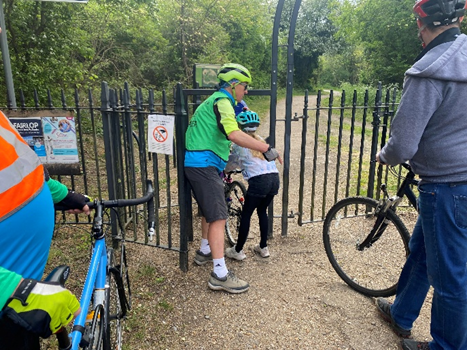
In June 2024 the Council took the decision to partially remove the cycle barriers at the entrances to Claybury Park on Roding Lane and Acle Close. That got a Hooray from RCC. The decision meant that more (but not all) cycles could get access to the park and could use the cycle track through the park. As you can see the track is recorded as part of the Borough’s existing cycle network (see below).
Well, the improved access didn’t’ last long …
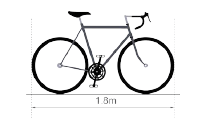
The Council has now re-instated the barriers, effectively restricting access to just those cyclists who ride one of these (straight handlebars/gravel bike bars allowed if they are not too wide).
We are not best pleased …
We have made a freedom of information request to the council to find out what is behind the decision. Once we receive a reply, we will take the matter up with the relevant person(s). At that point we may also ask for your help by writing to councillors or by signing a petition.
Here’s the text:
In June 2024 the Council took the decision to partially remove the cycle barriers at the entrances to Claybury Park on Roding Lane and Acle Close. The Council has now reversed this decision, re-instating the barriers.
Local Transport Note 1/20 paragraph 1.4.2 defines a cycle as follows:
‘For the purpose of this document, the term cycle refers to the full range of vehicles shown in Figure 5.2 in Chapter 5 and described in the accompanying text, including hand-cranked cycles and cycles that conform to the Electrically Assisted Pedal Cycle Regulations 1983 (as amended)’.
The council’s decision to re-instate the cycle barriers means that most types of cycles, as defined in LTN 1/20, will no longer be able to gain access to the park or only with considerable difficulty. Those adversely affected by this decision include those riding
cycles with child seats (parents and children),
cycles with tag-along trailers (parents and children)
cycles with buggies (parents and children)
hand powered cycles (people with disabilities)
tricycles (people with issues balancing, for example people who have suffered strokes or who have multiple sclerosis)
tandems (where the rear rider for some reason is unable to ride a solo bike)
Under the Freedom of Information Act and in relation to the Council’s decision to re-instate the cycle barriers at the gates to Claybury Park on Acle Close and Roding Lane I request the following information.
The position of the officer(s) or councillor(s) who took the decision to reinstate the cycle barriers.
A copy of any summary report or report setting out the case for re-instating the cycle barriers considered by those who took the decision.
What criteria were used to assess the impact of the partial removal of the cycle barriers? If none please say so.
If criteria were used, please provide the document containing the assessment against these criteria of the impact of partially removing the cycle barriers .
The minutes or notes of any meetings held to consider reinstating the cycle barriers. If none please say so.
The total number of instances of anti-social behaviour in Claybury Park reported to the Council in the period 1st June 2024 to 31st January 2025.
The number of instances of anti-social behaviour in Claybury Park reported to the Council involving cyclists in the period 1st June 2024 to 31st January 2025.
The number of instances of anti-social behaviour in Claybury Park reported to the Council involving motor cyclists in the period 1st June 2024 to 31st January 2025.
For the period 1st June 2024 to 31st January 2025, any documents, emails or other communications that refer to any proposals or actions that council officers or others considered taking or took to reduce anti-social behaviour in the park prior to the decision to re-instate the cycle barriers. If none please say so.
All data collected by Council Officers or others that was considered by those making the decision. If none please say so.
A copy of any access audit carried out by council officers or others or the findings from an Equalities Impact Assessment on the impact of a decision to reinstate the cycle barriers on those cyclists who would no longer be able to access the park or only with considerable difficulty and in particular cyclists with disabilities. If no access audit or Equalities Impact Assessment was carried out, please say so.
For the period 1st June 2024 to 31st January 2025, all emails or documents written by council officers, council members or others that discuss or refer to the implications of re-instating the cycle barriers on those who ride cycles that will no longer be able to access the park or only with considerable difficulty.
Redbridge Cycling Campaign (RCC) is pleased that the Council has decided to draft and consult upon a Sustainable Transport Strategy.
We agree with the Council’s assessment of the Borough’s its current transport network stands and with what will happen if the Council does not act.
We agree with the proposed hierarchy of road users and with the Council’s intention to use it to rebalance street priorities.
We agree with the Council’s plan to use the movement and place framework when planning for the future of its road and street network. We think this has the potential to create streets that will allow residents to go about their daily lives on bicycle or foot.
But …
We do not think that what the Council says that it is going to do and the targets that it is proposing to set are anywhere near ambitious enough. As they stand, the actions and targets will not deliver what the Council says it wants to achieve and will not keep Redbridge moving.
The problem with journeys made by car that threatens to undermine the strategy’s aims.
On the face of it, the target of reducing car journeys from 47% to 33% of all journeys made by 2041 looks laudable. However, this target needs to be seen in the context of an increasing population and so an increase in the total number of journeys made: more people mean more journeys. When we do the sums, 33% of journeys made in 2041 may not be a hugely different number to 47% of journeys made in 2021.
So even if the Council could achieve its target of reducing car journeys to 33% of all journeys, traffic volumes could still be such that the Borough’s road network will be at, or close, to full capacity (because it already is). This will mean that all the current problems the Council describes in the introduction to its strategy (p8), and which it wants to address, will remain largely unsolved.
There are also reasons to think that the Council’s approach to reducing the percentage of journeys made by car will fail. Although the Council is proposing measures to reduce motor traffic speed it is not proposing measures to reduce motor traffic volumes or to stop drivers rat running along what should be quiet residential streets – a problem that is likely to get worse as navigation apps increasingly route drivers along residential roads to avoid junctions and traffic lights on more major roads.
This is at odds with the Council’s stated intention to rebalance street priorities. Rebalancing street priorities must include reducing traffic volumes on residential roads and this must mean introducing schemes to restrict motor traffic either by installing physical barriers or cameras.
We think that the only way to stop Redbridge coming to a halt and for the Council to meet its ambitions is to place much more emphasis on wheeling, walking and cycling.
The role of cycling in achieving the Council’s aims
We think the ambition to shift the percentage of journeys undertaken by cycle from 1% in 2021 to 3% in 2041 is woefully short of ambition. The Council’s proposed cycle network included in its plan (p32) is simply inadequate: it lacks coherence and connectivity. But if the Council only expands its cycle network as set out on pages 31 to 33 then just 3% of journeys being made by bike by 2041 may be all that we can hope for.
On the other hand, if the Council is serious about rebalancing its street priorities using the proposed hierarchy of road users and a movement and place framework then there is every reason to think that travel by cycle should account for a much greater share of the journey’s residents make.
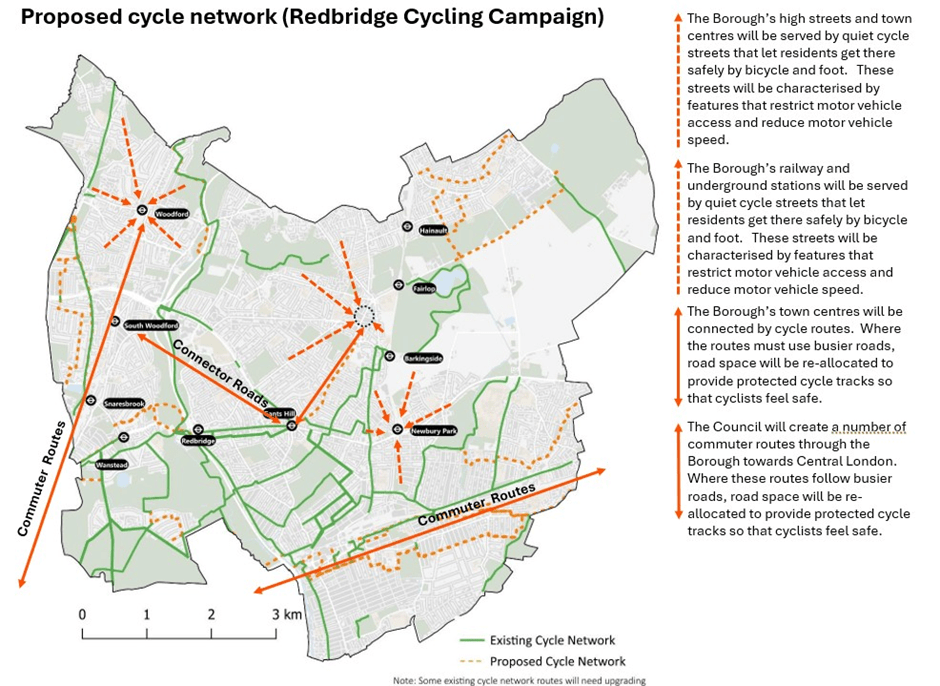
We think that to achieve its ambitions the council needs to replace the proposed cycle network (p32) and associated targets with an expanded network along these lines:
The proposed network should comprise:
Commuter routes through the borough towards Central London. Where these routes follow busier roads, road space must be re-allocated to provide protected cycle tracks so that cyclists feel safe.
Routes connecting the borough’s town centres. Where the routes must use busier roads, road space must be re-allocated to provide protected cycle tracks so that cyclists feel safe.
Quiet cycle streets that let residents travel safely by bicycle and on foot to the borough’s railway and underground stations and schools. These streets will be characterised by features that restrict motor vehicle access and reduce motor vehicle speed.
Quiet cycle streets that let residents travel safely by bicycle and on foot to the Borough’s high streets and town centres. These streets will be characterised by features that restrict motor vehicle access and reduce motor vehicle speed.
Only a network built along these lines – incorporating quiet streets, protected and segregated cycle tracks – will allow residents to choose cycling to a means go about their daily lives and see the required reduction in journeys by car.
Risks to the successful implementation of any Sustainable Transport Strategy
We think that there are three significant risks to the successful implementation of the strategy that are within the control of the council.
First is a lack of political will. It is not enough for the relevant cabinet lead member to be committed to the strategy; the commitment must start at the top with the leader themselves. Without the commitment of the leader of the Council it is likely that the plan will not be made a priority and so will not receive the resources that it needs.
Next there is the risk that commitment to the plan is not communicated to officers and that councillors are too prepared to listen to reasons why things cannot be done.
Finally, there is the risk that there are not enough officers employed to carry out the work and/or those that are employed lack the skills, knowledge and understanding needed to bring to life to concept of a network of cycle safe streets through well designed schemes and to be able to write bids to secure the funding the schemes need.
If any or all these risks occur, then funding will go to other Boroughs and the strategy will fail.




 Redbridge Cycling Campaign