The deadline for responding to consultations is 18th December 2025.
You can respond by following the link in the email sent to members on Friday 12th December.
We have now prepared our responses to the Wanstead Village and South Woodford Road Safety schemes. Both proposals are limited because they put forward measures to reduce traffic speeds but not measures to reduce traffic volumes. Reducing accidents, deaths and injuries needs both.
South Woodford
The key points are:
Remove the one-way streets in the area.
Include anti rat run measures to reduce traffic volumes.
Wanstead Village
The key points are:
Rethink the proposals for New Wanstead, Herman Hill and Chigwell Road to reflect the volume of traffic using the roads and their function as connector roads and to avoid the risk of making things worse.
Include anti rat run measures to reduce traffic volumes.
Barkingside
The key points is
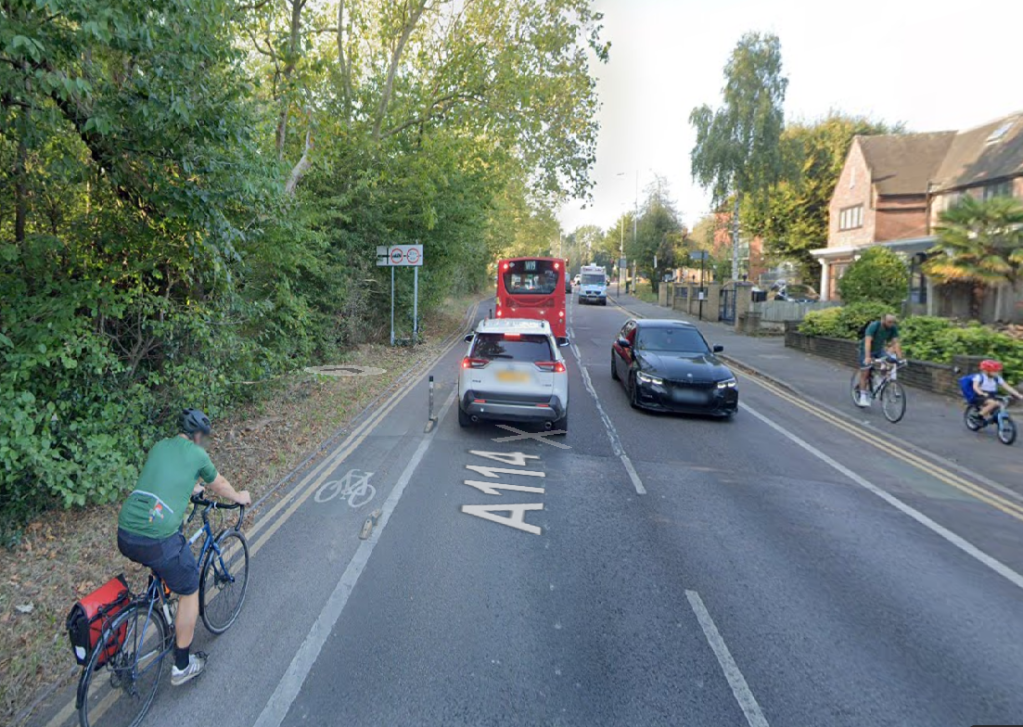
Cranbrook Road is where the many accidents happen, but the scheme does nothing to enforce a 20mph speed limit on the road
Something needs to be done at Gants Hill roundabout – and we have a proposal.
The other consultations
Pressure of time means that we are now unlikely to be make a detailed response to the Hainault scheme, but we are pleased to see the Council proposes reducing the speed limit on Forest Road to 30 mph.
You can read our response to the South Woodford scheme here.
You can read our response to the Wanstead Village scheme here.
You can read our response to the Barkingside scheme here.
If enough of us ask the Council to spend more on cycle infrastructure it’s possible that it might – especially as improving the provision for cyclists is an essential to implementing the Council’s Sustainable Transport Strategy:
“We have adopted a sustainable transport “road user hierarchy “which simply states that in our future decision-making, whether that be investments, how we designer scheme or our policies, we will consider the needs of certain people, ways of travelling and vehicle types before others.”
So, allocating more money to cycling will be the Council putting its money where its mouth is …
If we don’t ask for what we want, we will lose out to others who do. The survey is quick and easy. The two key questions are 3 and 4. Here are my answers to those two questions.
Q3. An independent nationwide survey carried out by IMPOWER saw Redbridge ranked as the most efficient and best value for money council in London and 2nd best in England. Though proud of this we’re not at all complacent and know there’s always room to improve. With that in mind, what could the council be doing that would make a positive difference for you?
A: Investing more, both in terms of money and staff, in cycling. The Borough should have a network of safe cycling routes so that residents can use bicycles to go about their daily lives – going shopping, taking their children to school, going to the railway station, the GP etc. This needs investment and council officers with suitable skills and in sufficient numbers to carry out the work.
Q4. When it comes to setting a budget, much of what councils do today focuses on the things that we have to provide – essential services like making sure we’ve got enough social workers to help our most vulnerable children and young people and collecting your waste and recycling. Where we do have more flexibility, it would be helpful to know what your local priorities are.
Of the following, please tick up to three areas you’d want us to prioritise in the future
þHighways – maintaining roads and pavements, fixing potholes, managing water gritting, and improving road safety and walking/cycling routes.
a proposal to introduce a rat running reduction scheme in the Lake House estate area.
And
a proposal to introduce a 20mph zone in the Wanstead area, covering the area south of the A12 and west of the A406 up to the Borough boundaries with Waltham Forest and Newham.
The closing dates for the consultations are 5th June 2025.
These are road safety schemes – they are intended to reduce deaths and injuries caused by road traffic accidents – rather than schemes designed to promote cycling and walking. But these schemes do effect cyclists and, if well designed, they can make cycling and walking more attractive options for more people. What you are reading now are our views on the schemes from a cyclist’s point of view. Other points of view are available. …
We have had a first look at the proposals and there’s a lot to like. This post sets out our first thoughts. As we think about the schemes more it’s quite likely that we will refine our thoughts and want to add some further comments. If we do, we will post an update on our website.
So, if you haven’t already responded to the surveys you might want to hold off doing so until nearer to the closing date. If you have already responded (well done) and you want to add anything in the light of what we have written, you can email your additional comments to traffic.schemes@redbridge.gov.uk.
Please feel free to use any of our comments in your response.
Before we look at the specific schemes in detail here are a few general remarks.
The areas covered by the proposals are almost all residential and so a speed limit of 20 mph is entirely sensible. The arguments sometimes used against 20 mph zones (which we don’t buy) that slowing down traffic across entire areas can clog up roads, delay journeys and hit productivity, especially for trades people and small businesses, won’t apply.
There’s no doubt that cyclists and pedestrians will welcome slower speeds. Cyclists will feel safer on the effected roads. If a cyclist is in a collision with a motor vehicle going at 20 mph, they are less likely to be killed or seriously injured than if the vehicle is travelling at 30 mph.
Transport for London have just published the findings of an extensive study of more than 150 20mph schemes implemented during this period 1989 to 2013. The study found:
That introduction of 20mph schemes led to a 40 per cent reduction in fatalities, falling from 15 to just nine, compared to a background trend of seven per cent fewer deaths across all borough roads.
Child safety improved dramatically with a 75 per cent reduction in children killed and a 50 per cent reduction in child casualties.
A 35 per cent reduction in collisions and a 36 per cent reduction in casualties on roads with 20mph limits.
It’s really what you would expect.
The seven pinch points at the traffic islands along Aldersbrook Road have long been a source of complaint amongst local cyclists. The cycle tracks end at the traffic islands where motor vehicles must move in towards the kerb and into the path of cyclists. Many a regular user of the cycle tracks will tell you how they have nearly been knocked off by cars swerving towards the kerb. Redbridge Cycling Campaign and individual cyclists have lobbied council officers and local councillors to do something about them and so, the proposal to remove two of them is welcome. But that still leaves five.
We can understand the problems of removing the two islands with speed cameras on them but why not replace the other three with zebra crossings? This would help pedestrians and it would make cyclists using the tracks along Aldersbrook Road feel safer. Why is this important? Because it is only when potential cyclists feel safe that they get on their bikes and become cyclists. And current cyclists coming from the Manor Park direction (for example from the Railway Station) could also use the zebra crossings to exit from Aldersbrook Road into the turnings of the Aldersbrook Estate – now it’s a difficult manoeuvre. So, we think more zebra crossings will be a win all round.
We are pleased to see that the Council plans to instal sinusoidal speeds humps – these are the most comfortable design for cyclists.
We will be supporting these schemes. Could they be improved upon to support the Council’s ambitions to see more people on bikes? Yes, and here’s how …
Lake House Rat Running Reduction Proposal
The proposal to introduce a No Entry Except for Access Restriction between 7 and 10am and 4 and 7pm is welcome but:
The success of last April’s Aldersbrook Bicibus event (parents and children riding to Aldersbrook School) proved that parents and children from the Lake House Estate want to get to school by bike. The timed no entry restriction will help create quiet roads on the estate that will be suitable for these parents and children to cycle – especially in the morning. If the afternoon timed restriction started at 2.30 or 3 pm then this would be better, removing the risk that parents and their children might meet early bird rat runners.
It’s hard to see why the restriction is not permanent: if rat running isn’t a problem between 10 am and 4 pm there is no harm in the restriction being in place because hardly anyone is nipping through the estate – and those few shouldn’t be because the main roads are OK.
Of course, the problem is that parents cycling from Lake House to Aldersbrook School then must cycle down Woodlands Avenue. This is not a cycle friendly street, but we think that there is a solution – more on that below.
Wanstead Area Road Safety Zone (South-West Area)
Replacing the traffic island at the junction of Queenswood Gardens and Aldersbrook Road with a zebra crossing is a good idea. It will provide better pedestrian access to the bus stop on the opposite side of the road, and we expect it will be welcomed by pedestrians.
As we mentioned above, Woodlands Avenue, despite having (fierce) speeds humps is not cycle friendly. With cars parked on either side of the road the effective carriageway is narrow and motor vehicles push past cyclists. The Avenue is also a rat run: motor vehicles travelling in the direction of Wanstead use Park Road and Woodlands Avenue to avoid the mini roundabouts. We think there is a solution: make Woodlands Road a school street with, in the hours of the school run, restricted access. This would mean installing cameras at either end of the road facing onto Park Road and Blake Hall Road. Motor vehicles trying to turn into Woodlands Avenue would be ticketed. Because the cameras face outwards, residents driving out of Woodlands Avenue go undetected, so they are fine. Residents can apply for an exemption so that they can drive into Woodlands Avenue during the restricted hours.
Wanstead Area Road Safety Zone (South-East Area)
Once again, replacing the traffic island at the junction of Empress Avenue and Aldersbrook Road with a zebra crossing is a good idea. It will help cyclists by removing one of the dangerous pinch points on Aldersbrook Road.
Motor vehicles do speed along Wanstead Park Avenue and so speed reduction measures are appropriate.
Wanstead Area Road Safety Zone (North Area)
There is a rat run through this area from the A12 along Redbridge Lane West, Langley Drive and Overton Road to Blake Hall Road. The council, rightly, thinks the Lake House estate needs a rat running reduction scheme. So surely the residents of this area deserve on too? And, of course, Wanstead High School is on the rat run.
St. Marys Avenue links Wanstead High Street to St. Mary’s Church and Wanstead Cricket, Golf and Tennis Clubs. It should be a cycle friendly road – one you can cycle along with your children as they go to their cricket, golf or tennis lessons – or to church! But it isn’t.
Many motor vehicles can straddle the speed pillows and so can, and do, disregard the speed limit. This puts off potential cyclists: parents will be driving their children to cricket etc. instead of cycling with them. The position of the pillows in relation to the kerb means that motor vehicles swerving into cyclists’ line of travel. If speed humps are right for all the other roads in the area, then surely, they are right for St Marys Avenue too. So, we think the pillows should be replaced by humps.
Can the scheme include improving the pedestrian crossing outside Wanstead House?
You can also make a bespoke response by sending an email to sts@redbridge.gov.uk
This post sets out our thoughts on the 4 questions in the survey that allow free text answers. If you plan to respond to the consultation using the survey form and you are inclined to agree with us, feel free to cut and paste – but change we to I.
Redbridge Cycling Campaign and London Cycling Campaign will both submit bespoke responses.
So, here’s what we think …
7. Please tell us about any other things you face frequently on your journeys in or through the borough that you wish to tell us about.
Please also remember to use the map at the bottom of the main page to pinpoint specific things to us.
To date the borough has made very limited and disjointed provision for cyclists. Almost every journey involves passing through difficult junctions and cycling along roads without the required degree of protection. Close passing, being chased down between speed humps, cars parked in cycle lanes and speeding vehicles are features of almost every journey.
11. Please tell us about any your thoughts on the potential challenges and priorities of the Sustainable Transport Strategy that you wish to tell us about.
The council’s assessment of what will happen to traffic if it does nothing looks sound and realistic. Doing nothing is not an option. We agree that street priorities need rebalancing. We agree that the best way to rebalance priorities is by analysing the borough’s road network using the proposed movement and place framework and the hierarchy of road users. This should provide a clear picture of what needs to be done.
We think that there are three significant risks to the successful implementation of the strategy that are within the control of the council. First is a lack of political will. It is not enough for the relevant cabinet lead member to be committed to the strategy; the commitment must start at the top with the leader themselves. Without the commitment of the leader of the Council it is very likely that the plan will not be made a priority and so will not receive the resources that it needs. Next there is the risk that commitment to the plan is not communicated to officers and that councillors are too prepared to listen to reasons why things can be done. Finally, there is the risk that there are not enough officers employed to carry out the work and/or those that are employed lack the skills, knowledge and understanding needed to bring to life to concept of a network of cycle safe streets through well designed schemes and to be able to write bids to secure the funding the schemes need. If any or all of these risks occur, then funding will go to other Boroughs and the strategy will fail.
16. Please explain why, if any of the key goals do not meet your needs or if you want to tell us about any other actions you want us to include?
Please also see our long list of actions for the strategy that provide a more comprehensive list of actions per theme, see link.
We have no comments to make here.
17. Do you have any other comments about the draft Sustainable Transport Strategy?
The Sustainable Transport Strategy has plenty of excellent stated ambitions, but the detailed plans aren’t anywhere near bold enough to achieve them. The proposed cycle network included in the plan is simply inadequate: it lacks coherence and connectivity. The proposed network should comprise
Commuter routes through the borough towards Central London. Where these routes follow busier roads, road space must be re-allocated to provide protected cycle tracks so that cyclists feel safe
Routes connecting the borough’s town centres. Where the routes must use busier roads, road space must be re-allocated to provide protected cycle tracks so that cyclists feel safe.
Quiet cycle streets that let residents travel safely by bicycle and on foot to the borough’s railway and underground stations and schools. These streets will be characterised by features that restrict motor vehicle access and reduce motor vehicle speed.
Quiet cycle streets that let residents travel safely by bicycle and on foot to the Borough’s high streets and town centres. These streets will be characterised by features that restrict motor vehicle access and reduce motor vehicle speed.
For reference an indicative map showing such a network can be found in a post on the Redbridge Cycling Campaign website in a post headed ‘To boldly go ‘ dated 5th December
Let’s imagine it’s 2032 and that Redbridge’s Sustainable Transport Strategy is a success. What might a newspaper article reporting the success say?
The Ilford Courier
1st April 2032
By Mikael Moreno
On yer bike, Redbridge’s Sustainable Transport Strategy has a tailwind behind it.
Following a consultation Redbridge Council launched its Sustainable Transport Strategy (STS) in early 2025. The premise was hard-headed: unless something was done, by 2041 if not sooner, Redbridge would grind to a halt. Now, in 2032, the strategy is on course and Redbridge is still moving, so how and why has Redbridge made such good progress?
During the 2024 consultation many of those responding highlighted what they saw as the mismatch between what Redbridge said it wanted to achieve and what it planned to do.
By 2028 Redbridge wasn’t seeing the hoped for switch to cycling and walking. Neither traffic volumes nor traffic speeds were reducing, and residents were telling the Council that they still did not feel confident cycling around the Borough. The Council also identified two new problems. More and more SUVs could negotiate speed humps at speeds close to 30mph, rendering the humps ineffective, and navigation apps were routing drivers along unsuitable residential roads to avoid junctions and traffic lights on more major roads. If anything, the traffic situation was getting worse rather than better.
At the same time, hopes were fading that residents would choose to use buses rather than their cars, not least because the buses were stuck in traffic and the road network couldn’t accommodate more, new, bus lanes. And the rail and tube networks were running at full capacity and extending these networks was beyond anything the Council could do.
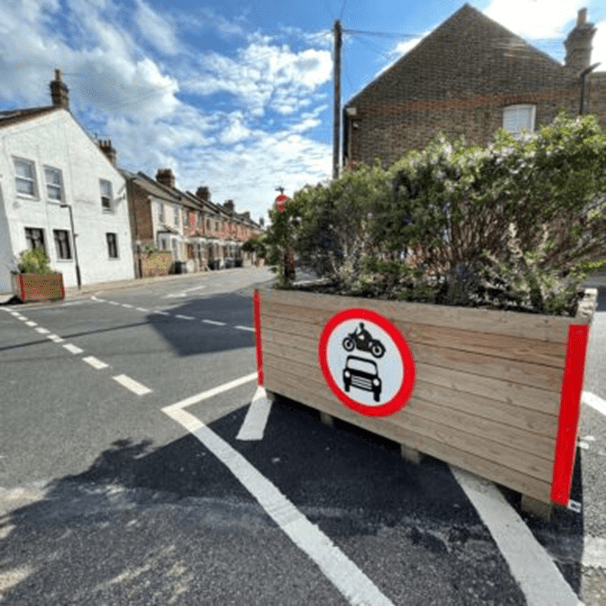
So, what to do? Brompton Verdi, the Cabinet Member for Transport told me, ‘We realised that creating a shift to cycling was the only way to stop Redbridge coming to a halt and that we need to change our strategy if we were going to achieve this’ The council decided to put more emphasis on creating the conditions residents needed if they were to get on their bikes. Verdi went on to tell me ‘We prioritized routes into our town centres, schools and the like, because this is where we felt we could have the biggest and quickest impact and because it built on our successful Schools Streets programme’. And because Redbridge is a compact Borough, separate routes to two adjacent town centres could often be combined to form a route connecting the town centres. ‘We knew that most of these routes could not be along segregated or protected cycle tracks and that cyclists would need to use the carriageway. So, the carriageway needed to be made safe for them to do this’, Verdi said. The Council started to introduce road closures, either by putting in physical barriers through which bicycles but not motor vehicles could pass (modal filters) or by using. cameras. Of course, by 2028 this was not rocket science, plenty of London boroughs had already done this quite successfully.
Verdi told me that ‘we went about this in a planned and not an ad hoc way. ‘We asked our Highways staff to install the closures necessary to allow residents to get into our town centres, stations, schools and leisure facilities along safe quiet cycling routes. We told them that they were not to leave gaps in the routes because it was too difficult – which usually meant Highways thought car drivers would be put to too much inconvenience. We reminded Highways staff that the council was committed to reallocating road space in favour of cyclists as a precursor of encouraging more cycling and that they had to find solutions. We knew that very few of our Highways staff were cyclists and that this was a weakness. To compensate we told Highways that they were to involve local cycling groups and bicycle riding residents at an early stage in the design work to make sure we got it right. And 9 times out of 10 they did’.
‘What we did wasn’t always popular with everyone – especially in the beginning – but opposition often seemed to evaporate, and we felt we had a mandate to proceed – we had consulted widely on the strategy and the Council had a large majority. If residents hadn’t liked what we are doing, they could have voted us out’.
As the Council rolled out its cycling streets it saw journeys made by bicycle start to increase. ‘This gave us the confidence to continue and to be more ambitious – it was clear to us that there were plenty of residents who were happy to cycle if the conditions were right. The Council also noticed that residents of the areas covered by quiet cycling streets started to report feeling safer’.
When the Council investigated it found that the presence of cyclists made the streets feel less empty and deserted. It turned out that those engaged in street crime and antisocial behaviour were more bothered by being happened upon by a cyclist than being passed by a car driver. So this helped the Council make progress towards another of its targets which was to making its streets safer for female residents.
Success breeds success. The success of the cycling streets meant the Council was able to bid successfully for more and bigger schemes.
Let’s give the last word to Brompton Verdi. ‘We were right to change tack in 2028 and to focus on cycling. And I think those who said we weren’t trying to do enough were right. We’re now well on the way to meeting the aspirations we set out in our Draft Strategy and, in 2032, Redbridge is still moving.



 Redbridge Cycling Campaign