The London Borough of Redbridge has launched a consultation on its draft Sustainable Transport Strategy. The consultation runs until 5th January 2025.
We will be discussing the strategy at our next two meetings and will hear from Council Officers at the next meeting of the Redbridge Cycling Forum in November.
We have also sent the link to the people at LCC central to see what they think.
As our thinking crystallises we will put up updates to this post.
RCC has enthusiastically supported all the council’s previous school streets proposals, and we are supporting this next set of proposals too. For the first time Redbridge are proposing to create school streets at secondary schools. This is a logical development, but it does throw up a new problem.
‘School Streets aim to reduce levels of air pollution around our schools, making the air children breathe cleaner. They protect children from traffic hazards at the school gate, preventing accidents and keeping children safe. Students are also encouraged to walk and cycle to school, improving health and fitness’.
When it comes to secondary schools it’s the last aim that’s the problem.
No doubt many of those dropped off by car could easily walk to school but secondary schools do have much larger catchment areas than primary schools so some pupils who, at the moment are dropped off, would face a long walk to school. This is unlikely at a primary school. Of course, pupils can swap their parents’ car for a bike but only if the School Street scheme is complemented by the Council creating safe cycle routes to the school from all corners of the catchment area. This is do-able.
I have looked one of the schemes at a secondary school that I familiar with and, from the outer reaches of the catchment area, cycling to school instead of going by car is not an option. There just aren’t routes that parents will consider safe for their children to ride. So, to the extent that all secondary school schemes suffer the same problem, the shift to active travel will be limited. More likely what will happen is that the drop off points move.
If you think School Streets are a good idea support the schemes – so your response goes in the ‘yes’ pile – but in your response say that, to fully achieve its aims the council must introduce cycle routes (cycle streets as they are called in Germany) and traffic reduction measures across the catchment area to make cycling to school a safe and realistic choice.
The closing date for these consultations is 21st October 2024.
We recently rode through Claybury on our Redbridge Parks Ride. The route has been immensely improved by the nibs being taken off the bike barriers. No more removing panniers, lifting children from their child seats and lifting heavy electric bikes over the railings. Tricycles, cargo bikes and tandems can now use this route across the park linking Roding Valley Way and Fairlop Waters. Thank you Vision and Redbridge. A great improvement.
For those interested, here is an update on Britannia Road. A new crossing may seem small beer but for us it’s important. The scheme is not a cycle infrastructure scheme per se – there aren’t many of them – but is a road safety improvement scheme, of which there are many more. Like many road safety improvement schemes, it will have an effect on cyclists. Clued-in councils are often able to piggy-back improvements to cycling infrastructure onto these schemes. On the other hand, councils (even well-meaning ones) who don’t think enough about cycling can implement these schemes in a way that makes things worse. There is a risk that this scheme becomes a case in point.
To be fair, we are talking here about an initial proposal. Council officers have acknowledged our worries and told us that they will be considered in the forthcoming detailed design phase. So, plenty to play for.
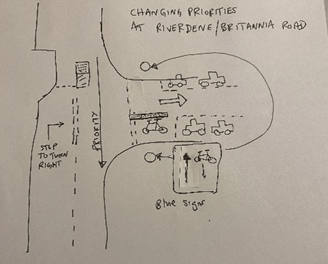
We have now met with officers at Britannia Road. Much of our discussion centred on the ‘contraflow’ cycling along Britannia Road. The big issue is at the junction of Riverdene and Britannia Roads. Only it isn’t really a junction. Britannia Road is not, for now, a turning off Riverdene Road. Vehicles driving north along Riverdene Road don’t have to stop and do a right turn into Britannia Road across oncoming traffic; drivers simply go round a corner and into Britannia Road: Riverdene Road/Britannia Road is a continuous road that turns through 90 degrees. It’s not the standard road layout envisaged for contraflow cycling that you can find in the Department for Transport’s Local Transport Note (LTN) 1/20.
When we met, we saw cars cutting the corner of Riverdene Road/Britannia Road. Drivers followed a line exactly where cyclists riding from Ilford Lane would be (between 75 and 100cm from the kerb). And that is before Britannia Road is made one-way. Once it is, drivers turning the corner of Riverdene Road/Britannia Road will expect a clear run and the temptation to cut the corner will be greater. And we know that they will be travelling faster.
LCC has told us that corner cutting at the exit of cycle contraflows has caused accidents in other boroughs.
We think the junction can be re-configured and here’s a starter for 10 …
Drivers who previously turned right off Ilford Lane into Britannia Road will now come down Bengal Road, turn right into Riverdene Road and right again into Britannia Road. This creates an extra right turn across Cycleway C42, making C42 more dangerous for cyclists because, as you know, most accidents involving cyclists happen at junctions.
Our conclusion is that, unless the Riverdene Road/Britannia Road turning is reconfigured in the detailed design, the scheme will make things more, rather than less, dangerous for cyclists – and will be perceived by cyclists as dangerous. That means that cyclists will avoid using the route – including me.
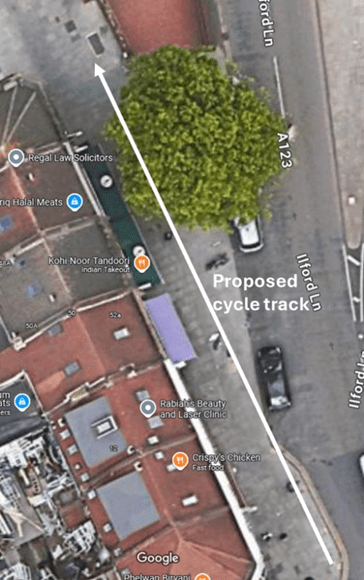
I think I would use the new crossing, ride along the pavement to Audrey Road and go down there which, incidentally, is on the London Cycle Network and is signed as such. So maybe the Council could build a short section of cycle track between Audrey Road and the crossing? You don’t get what you don’t ask for, so if you think we are right and have the time, why not email the Council, tell them you are worried and ask for improvements to be made in the detailed design? Or, if you live in the area, go to your councillor’s surgery and talk to them about the scheme.



 Redbridge Cycling Campaign