This looks like a very good scheme. We understand from the Council that the path will be a bridleway and so open to pedestrians, cyclists … and horses. In effect the path will extend the Roding Valley Way southwards to Ilford putting a valuable leisure cycling route within reach of a lot more people. For those of you not familiar with it, the Roding Valley Way provides a good route from Wanstead Park to Ray Park. It is suitable for all kinds of bike with the probable exception of Tour de France style racers.
We think the extent to which cyclists will actually take advantage of the path is going to depend on the extent to which the Council can provide a network of segregated, traffic calmed or quiet cycle routes to its start.
We haven’t seen the plans for the cycle route running from Newham into Ilford along the Ilford Western Gyratory so at this point we can’t comment on this part of the scheme.
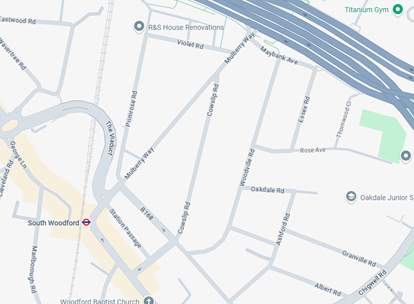
Council Officers have told us that Britannia Road will remain two way for cyclists. This is good news, but as anyone who has ridden the roads in the Oakdale area of South Woodford (see map) knows, one-way streets bring their own problems. Drivers are tempted to go faster because they know nothing is coming the other way, vehicles try and push past cyclists and drivers seem to have an enhanced sense that the road is theirs – cyclists and pedestrians don’t need one-way streets so if a street is one-wayed it’s for the benefit of drivers. So as the scheme goes forward, we will be talking to council officers about the best way to implement the proposal to make sure that cyclists will feel safe and confident about cycling along Britannia Road in both directions but especially ‘against’ the motor traffic. Because if cyclists don’t feel confident, they won’t use the route and a real opportunity to improve things for cyclists in the Ilford area will go begging.
For as long as I can remember, RCC has been campaigning to improve access to the park through the gates on Roding Lane North and Acle Close. We now have progress. The Council has removed the nibs on the barriers to allow a greater range of bicycles to be pushed through. It’s a welcome improvement but it’s not quite the real deal.
The Department for Transport’s Local Transport Note 1/20 (LTN 1/20) Cycle Infrastructure Design recommends that all cycle infrastructure allow passage of the Cycle Design Vehicle. What’s this? Well, it’s easiest to think of it as the smallest box into which all cycles – a tandem, a tricycle, a hand powered bike, a cargo bike – can fit. If this box can navigate a piece of cycle infrastructure, then the infrastructure passes the LTN 1/20 test. If it can’t it fails. The adapted barriers at Claybury Park still fail. But it’s an improvement. If everything goes well – the worry always seems to be motorbikes getting into the park – then we can argue that local residents and park users should not fear the Council making the park accessible to the Cycle Design Vehicle – that is to all types of cycles.
Here is our final response to the consultation. Fingers crossed the Council does make a safe arrangement for two way cycling along Britannia Road. If it does then we think we will have a new useful and high quality piece of cycle infrastructure in the Borough.
Our response is as follows.
We think this could be a good proposal – the crossing point lies on a natural line between Ilford Town Centre and the Ilford to Barking cycle route. Residents who live on streets that lead onto, or have easy access to, the Ilford to Barking cycle route will be able to exit that route at Britannia Road, use the crossing to enter Albert Road and then use the cycle route to the High Street along Mildmay Road and under Winston Way.
Of the two options we prefer Option 2. It is well designed, and it separates pedestrians and cyclists. Local Transport Note 1/20 (LTN 1/20) recommends this approach. On page 9, Summary Principles, we read:
‘Shared use routes in streets with high pedestrian or cyclist flows should not be used. Instead, in these sorts of spaces distinct tracks for cyclists should be made, using sloping, pedestrian-friendly kerbs and/or different surfacing.’
Option 1 does not meet this principle.
Our only issue with the scheme is the proposal to make Britannia Road one-way. At the moment cyclists can use Britannia Road to ride to and from Ilford Town Centre. If Britannia Road is made one-way then cyclists will only be able to use it to ride to the town centre. Theywill not be able to use it to for their return journey. And, when a road like this is made one way, it is likely that, unless speed reduction measures are introduced, drivers will drive faster. This is because drivers will know that no vehicles will be coming the other way – meeting on-coming traffic slows drivers down. This can make one-way roads more, rather than less, dangerous for cyclists. The Oakdale area of South Woodford has one-way roads like this, and they are not nice to cycle along. So, if Britannia Road is made one-way as proposed, this could make matters worse rather than better for cyclists and the potential benefits for cycling offered by the crossing will not be realised. The proposal is also at odds with the guidance given in LTN 1/20 which states:
‘Contraflow cycle lanes and tracks
6.4.21 There should be a general presumption in favour of cycling in both directions in one way streets, unless there are safety, operational or cost reasons why it is not feasible’.
We think that the Council can easily adapt its proposal to comply with the guidance given in LTN 1/20. We are aware of two ways of doing this:
Allow cyclists to ride the ‘wrong way’ along the road. There are examples of this arrangement in Hackney. If the Council adopts this approach, then we think it is important that it signals the contraflow arrangement at the junction of Riverdene and Britannia Roads. The Council can do this with road signs, but it could also consider putting in a traffic island to separate vehicles entering Brittania Road from Riverdene Road from cyclists coming along Britannia Road in the other direction (from Ilford Lane). But these contraflow arrangements can feel dangerous depending on the width of the road and the speed of oncoming vehicles. To an extent the Council can mitigate this perception of danger by the putting speed reduction measures.
Or Introduce a ‘point closure’ at the junction of Britannia Road and Ilford Lane making the road one-way at this point only but thereby stopping through traffic. As the rest of the road will be two way for the reasons we have given above, this will tend to reduce vehicle speeds. Drivers will expect oncoming vehicles – and so cyclists – and will reduce their speed accordingly. The Council introduced this type of closure on Nightingale Lane in Wanstead, and as far as we know it is a success.




 Redbridge Cycling Campaign