Official Response to Our Streets – Oakdale proposals

Written by Andrew Seager, Co-ordinator of Redbridge Cycling Campaign of behalf of Redbridge Cycling Campaign

The current position

I and another member of Redbridge Cycling Campaign (RCC) rode around the Oakdale area during the rush hour and school run on 8th September 2021. We saw very few cyclists, but a lot of through traffic, mostly cars with just one occupant. It was not a nice environment for cycling and, I think, many potential cyclists would see the area’s roads as hostile and choose not to make journey’s by cycle.


The effective width of the carriageways (once the space occupied by parked cars had been discounted) were sometimes less than 2m and most often were no more than 3m. We were subject to close overtaking and, where the carriageway was around 2m in width, cars tailgated us, impatient to push past.


Many of the roads are one way with clear lines of sight. Save for a few speed pillows (on Mulberry Road) that motorists could drive over with a wheel either side and which therefore wre doing little to reduce speed (but which did leave cyclists vulnerable to being hit or forced into the kerb by swerving cars) there was nothing by way of road design to deter rat running motorists from seeing 30mph as a target speed.


Where the speed limit was 20mph there was no enforcement nor had these carriageways been redesigned to make 20mph the safe speed limit or to indicate that the highway was for cars, cyclists and pedestrians. There are no speed humps, speed tables, road blocks, modal filters or chicanes.


We saw that Oakdale Road was, in effect, a drivethru for parents in cars dropping off their children. This forced all the other parents- off which there were many – who had walked their children to school onto the narrow pavements. This is an inequitable arrangement that sacrificed the amenity of the many for the convenience of the few (those driving their children to school).

The proposal

The Our Streets scheme in Oakdale aims to address the traffic issues in Oakdale, by ‘reducing through traffic and creating safer, quieter, and more attractive streets’.


The Sustrans website describes a Low Traffic Neighbourhood (LTN) as: ‘a scheme where motor vehicle traffic in residential streets is greatly reduced. This is done by minimising the amount of traffic that comes from vehicles using the streets to get to another destination. This is often referred to as ‘through-traffic’ or ‘rat-running’.

So the desired outcomes of the Oakdale scheme are pretty much the same as those for a Low Traffic Neighbourhood. There are many examples of successful LTNs in London that the London Borough of Redbridge (LBR) could learn from, but this scheme does not seem to model itself on them. Although the scheme has a number of the ingredients of an LTN they have not been combined in a way that will achieve the hoped for results and will not encourage more active travel. And several key features were missing.

Comments applying to the scheme as a whole

If the aim of the scheme is to reduce traffic and create safer quieter and more attractive streets then the scheme must prevent through motor traffic whilst enabling residents to drive into and out from the area in which they live. This can be achieved by entry/exit restrictions to and from the boundary roads, one-way streets that return traffic back to the area’s boundary roads – so that the one-way streets do not go anywhere but simply provide resident access. The proposals for Oakdale do not achieve this. This is a pity because a scheme that eliminates through traffic and which makes most streets calm and quiet would see cycling journeys increase and would help George Lane be a thriving destination and local shopping centre.

Whilst the scheme will see an increase in the number of one-way streets it does not eliminate through traffic. One-way streets in residential areas where the road network allows through traffic signal to motorists the prioritisation of the car and through traffic: it becomes a scheme to manage through traffic rather than to remove it. Any short term success such a scheme might have will, within months, be lost as released suppressed demand leads to an increase in through traffic volumes – essentially the same phenomena as that describe in the consultation Q&A.

In the absence of cameras or road designs that make travelling at more than 20 mph feel too fast, motorists, because they do not have to worry about cars coming the other way, will drive faster. Rat running motorists do not have the connection with the residents of the roads they are using as a through route – they have a disconnect with the area, they do not think ‘that pedestrian /cyclist lives two doors down from me’ and so feel little compunction to reduce their speed below the allowed maximum which instead they will see as a target speed.

As previously mentioned the effective carriageway widths of these roads make them hostile to cyclists. The scheme does not change this. This would matter less if thought had been given to providing a number of safe cycle routes through the area so that short journeys, for example to Oakdale School or the shops on George Lane, could be made by bike.

Finally, provision for pedestrians has not been improved by, for example, the introduction of speed tables at junctions.

Specific Comments

Restricted vehicle access Pultney Road

We can understand the thinking behind the proposal and can see that the introduction of a one-way barrier coupled with the closure of Cowslip Lane might well reduce through traffic moving north to south and south to north. Whether residents of the lower part of the Oakdale triangle will feel confident to cycle is another matter. Most short trips will involve entering George Lane and Oakdale’s one-way system. This is not a cycle friendly system and will deter potential cyclists. The proposal is likely to fail in its aim to encourage residents to choose cycling for short trips.

One way system on Granville Road and Albert Road

Local Transport Note 1/20 (LTN1/20) states

6.4.23 Contraflow cycle lanes should normally be mandatory, although an advisory lane may be considered where the speed limit is 20mph and the motor traffic flow is 1,000 PCU per day or less. The entrance to the street for cyclists in the contraflow direction should always be protected by an island to give protection against turning vehicles (see Figure 6.25) where traffic speed and flow is higher (p64)

And


‘Not only must cycle infrastructure be safe, it should also be perceived to be safe so that more people feel able to cycle’ (p8).

The proposals for Granville Road and Albert Road do not appear to comply with this guidance and will not feel safe to cyclist. If this is the case and there is an accident then LBR will be in a position that it would find hard to defend.

One-way system on George Lane and Victoria Road

The aim of this proposal seems to be to reduce congestion and traffic volumes. But it is very hard to see how this will happen: anything that is good for buses (other than their own lanes) will be good for cars. . George Lane, Daisy Lane and Victoria Road provide a through route east/west through Oakdale. If there is already congestion it is because motorists are using
this route. Even if the proposed measures improved things in the short term they will not in the medium and long term. Supressed demand coupled with car navigation systems that can immediately identify a reduction in congestion and re-route accordingly will quickly see new journeys being made through Oakdale: congestion will return and traffic volumes will
increase.

Overall, this is a scheme that tries to have its cake and eat it to: to continue to allow through traffic whilst hoping to achieve the benefits of an LTN. It cannot be done.

Things to consider if the scheme is re-though

Schemes that have successfully reduced traffic volumes typically have restrictions on the road entrances to and exits from the area, road blocks/closures, modal filters, and, to reduce speed and make things safer for pedestrians and cyclists, full width sinusoidal speed humps and speed tables at junctions used by pedestrians. These could all be used in the Oakdale area.

Create cycle routes that are safe and are perceived to be safe through Oakdale, so that residents can make the sort trips to the shops in George Lane and Oakdale School. For example officers might want to consider creating a cycle route along Pultney Road (which may need further filters to fully restrict its use to its residents thereby achieving traffic levels that will make residents feel confident to cycle) with a suitable crossing of George Lane into Cowslip Road, then along Station Passage and then, with another suitable crossing and by installing lightly segregated cycles lanes along the Viaduct on to the shops on the northern
section of George Lane.

Introduce an are wide 20mph speed limit coupled with physical measures to ensure motorists stick to this limit. At present Oakdale’s roads have speed limits of either 20mph or 30mph but, given its residential character, all the roads should have a 20mph speed limit. However given the problem of speeding this will mean making changes to the carriageways
and perhaps installing cameras.

Consider a ‘bus gate’ on George Lane to retain bus access with a camera to stop motorists using it as a through route.

Do something about the junction of Daisy Road, Cowslip Road and Victoria Road. This is very busy but is used by pedestrians on their way to and from Oakdale School. Perhaps the closure of Cowslip Road will reduce traffic volumes but we observed many vehicles driving down Daisy Road and into Victoria Road – which will still be possible. At the same time it seems that for many parents and pupils, this junction is on their route to school. Could the scheme not include a speed table or similar to make things easier for pedestrians?

Implement the school street proposal.

RCC at Wanstead Festival for Car Free Day 12th September!

Wanstead High Street was closed to car traffic from Christchurch Green down to Gail’s with a selection of farmers’ market stalls and other festival particpants on the road and on the green itself. The fine weather encouraged good attendance.

An Essex cycle charity running cycle events at the festival

It was fantastic to see many people cycling to and around the area, with lots of children getting involved on many different types of bikes having fun safely on a traffic-free section of the High Street. Tandem and penny-farthing bikes were witnessed in the area – maybe a new trend in Redbridge! A number of organised bike rides provided opportunity to get involved such as by TrailNet.

TfL had a stall and were publicising the upcoming extension to the ULEZ.

Mark from RCC had a chat to one of the TFL representatives, Jasvir, who was very knowledgeable about cycle routes in East London with many recommendations. Useful information about ULEZ and how to prepare for it was avaible and hopefully will encourage more people to cycle for some of the journeys!

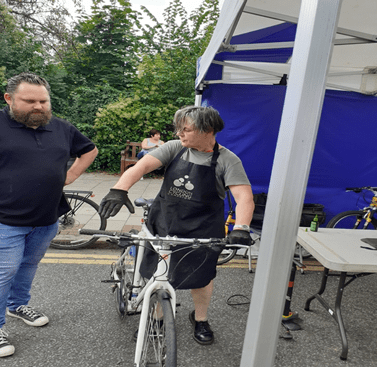
Dr Bike had a stall with two mechanics – perfect opportunity for a free bike check and fix! Unsurprisingly they were busy as usual. One of the mechanics works for Cycle Confident – great way to get free classes in Redbridge for those new to cylcing or wanting to gain more confidence on their bikes!

Dr Bike Wendy with an LCC apron!

Redbridge Cycling Campaign final response to the consultations on the proposed cycling and road safety improvements to Aldersbrook, Centre, Lakehouse, Blake Hall and Woodford New Roads.

We welcome Redbridge’s proposals – probably the most ambitious proposals the Authority has put forward to date.  We hope it will come to be the first of many and look forward to working with the Authority on future schemes. 

At the heart of the proposals are the establishment of a set of lightly segregated cycle tracks.  Cycle tracks and lanes can enhance the safety of cyclists, ensure a fair allocation of road space and can encourage people to choose cycling as a means of transport.  Department for Transport Guidance on cycle infrastructure design is set out in Local Transport Note 1/20 (LTN 1/20).  Guidance means that those designing cycle infrastructure should follow what is set out unless they have a good, defensible, reason not to.  Where we think we the proposals do not follow the guidance we have said so. 

We appreciate the honesty of the Authority in presenting these proposals as ‘preliminary measures and it is hoped that funding may be secured for future interventions such as improvements to assist pedestrians and cyclists at junctions in the area’ and very much hope that Authority is successful in securing the funding to deal with junctions at the beginnings and ends of the tracks.  As LTN 1/20 puts it

Junctions and crossings are where most conflicts occur, and the actual and perceived hazards are greatest.  Junctions are often the most hazardous and intimidating parts of a journey for cyclists. A junction that does not provide safe facilities may prevent people from cycling through the junction, but may also be the reason that people will not use the remainder of a route

The comments below inevitably focus on th difficulties we can see with the proposals but do need to read in the context of a broad welcome for a significant cycle infrastructure project. 

Comments that apply to all the proposals

If the rationale for introducing segregated cycle lanes -the main feature of these schemes – is because they represent cycling and road safety improvements then they need to be continuous and extend over as much of the distance between junctions as possible.  The gaps and the beginnings and ends of these lanes appear to be determined by the meeting needs of motor vehicles, for example where a traffic island means that the carriageway width is insufficient to accommodate a motor vehicles and a cycle.  Each time a section of segregated lane ends a cyclist will face a motor vehicle cutting in front of them from their right.  Most local cyclists have experienced near misses of this kind.  So the potential safety benefits of these schemes will be reduced. 

Bus boarders feature in all the schemes.  The boarder needs to feature a 0.5m buffer for pedestrians to alight onto and the cycle lane needs to remain at 1.5m (not be pinched to, for example 1m).  It is not clear from the documents provided in the consultation whether this will be the case. 

We note the Borough’s intention to install cycle lane delineators in the form of mini-orcas and orcas-with-wands, that these will be alternating at 4m intervals.  Where applicable, will this gap be sufficient to allow motorists to park between orcas/wands?  It has happened in other Boroughs. 

The cycle lanes bring cyclists into the mini roundabouts at the top of Aldersbrook Road or into the junction of Blake Hall Road, Bush Road and Overton Drive.  The consultation does not explain the method used to decide how close to the junctions the start/finish of the lanes should be but in some cases they seem to be further away than they need to be.  If the reason is for the convenience of motor traffic that would be a poor reason: motor vehicle convenience should not be a reason to sacrifice cyclists’ safety. 

The junctions at the end of these schemes remain far too hostile to enable people other than those who already deal with them to take to these roads safely and with confidence. 

In Department for Transport Circular 01/2013, Setting Local Speed Limits, the DfT write

84) Based on this positive effect on road safety, and a generally favourable reception from local residents, traffic authorities are able to use their power to introduce 20mph speed limits or zones on:

major streets where there are – or could be – significant numbers of journeys on foot, and/or where pedal cycle movements are an important consideration, and this outweighs the disadvantage of longer journey times for motorised traffic’.

Given that the purpose of these proposals is to improve cycling and road safety we would ask the Authority to set a 20mph speed limit on all the roads affected by the proposals: it is the combination of segregated lanes and lower speed limits that maximises the number of people choosing to cycle.  In all likelihood this would need to include the roads on the Alderbrook and Lakehouse Estates which otherwise, given that the majority of these roads have 30mph speed limits, will get selected by navigation systems as fastest routes leading to an unintended increase in rat running – this has happened in other Boroughs. 

Aldersbrook Road

  1. The decision to retain the traffic islands for pedestrian crossings and speed cameras and to end the segregated cycle lanes at these islands returning cyclists to the carriageway creates a number of pinch points.  LTN 1/20 states

7.2.4 Close overtaking can be intimidating and hazardous to cyclists in free-flowing traffic. Only at speeds lower than 30mph might a minimum clearance of 1.0m be acceptable. No values are given for speed limits greater than 30mph because cyclists should be provided with protected space away from motor traffic (see Figure 4.1).p74

7.2.9 ,,,  pinch-points should be designed in such a way that cyclists are neither squeezed nor intimidated by motor vehicles trying to overtake. The preferred option is to provide a bypass or alternatively sufficient lane width (more than 3.9m) so that the cyclist can remain in the secondary position and be overtaken safely.    When width is insufficient for a bypass, the carriageway width is restricted to prevent overtaking.  This will not be desirable over long lengths unless motor traffic volumes are also very low, as cyclists will feel intimidated by vehicles waiting to overtake.  Gaps between kerbs (or kerb and solid white centre line) should be a maximum of 3.2m. As noted above, widths between 3.2m and 3.9m may encourage close overtaking by motor traffic at pinch points and should not be used. P77

Using the measurement app on an iPhone we found the at the pinch point n with junction of Empress Avenue to be 3.3m.  We imagine the other pinch points are about the same width.  Therefore the minimum clearance for cyclists of 1m for speeds less than 30mph cannot be met.  In fact the width of the carriageway, falls within the range pinch points should nit be used.  (para 7.2.9). 

  • We have noted the Borough’s comments regarding speed cushions and that ‘motorists will find it difficult to avoid the speed cushions when travelling in Aldersbrook Road as they are proposed alongside segregated cycle lanes with delineators, or in conjunction with pedestrian islands’  However we are not persuaded.  It is the view of the London Cycling Campaign and, we understand, recognised best practice, to instal full width sinusoidal speed humps or tables.  Light segregation in the form of cycle lane delineators coupled with speed cushions have been installed on Forest Road between Manor Park Station and Capel Road.  It is not very effective in reducing traffic speeds as most vehicles can drive over the cushions a wheel on either side. 
  • We note the Borough’s intention not to allocate any mini-orcas or orcas-with-wands, at junctions to leave an adequate distance for cyclists to manoeuvre out of/into the cycle lane in a safe and timely manner.  In deciding where to a break the line of  orcas and wands the Authority needs to bear in mind he range of cycles that exist.  LTN q1/20 para 5.4.1 says

It is important that infrastructure can accommodate the full range of cycles to ensure routes are accessible to all cyclists

Turning right from Aldersbrook Road into one of the estate roads is a manoeuvre that will need to be executed with confidence and at a reasonable speed.  Experienced cyclists on solo bikes will manage this but less experienced cyclists, children and some cyclists with disabilities and adapted bikes may well not.  It is not acceptable if cyclists other than those who are experienced are forced to dismount and cross as pedestrians

  • Finally we think that the segregated lane may send a signal to motorists that this is where cyclists should be and so they will not be expecting a right turn manoeuvre – making things worse than they are now. 
  • We do not understand why there are no segregated lanes between Brading Crescent and Harpenden Road. 

Centre Road

Light segregation in the form of cycle lane delineators seems a good solution to the issues this road poses for cyclists.  We have only one comments

  1. Why does the lane going north from Forest Gate towards Wanstead not start where the houses on Woodgrange Road end? 
  2. Looking at the proposals from a pedestrian point of view is a raised speed table with a speed limit of 30mph more or less safe than an island with a 40mph speed limit? Table

In answer to a query regarding the proposed raised speed table an officer told us that the proposed reduction of the speed limit from “40mph” to “30mph” in Centre Road, paired with the kerb-to-kerb speed hump on the approach to the crossing point, narrowing of the lane width available to vehicles and warning signs/ road markings will assist in reducing the speed that vehicles travel in Centre Road and thus, improve road safety for all road users and of those crossing at this particular point.  Does the s peed hump on the approach efer to the table as no speed hump is shown in the drawings provided for the consultation. The drawings show a carriageway wide at the crossing that is wide enough for two way traffic which will be approaching at 30mph.  will this be safe?

Lakehouse Road

Light segregation in the form of cycle lane delineators seems a good solution to the issues this road poses for cyclists.  We can see no specific issues. 

Blake Hall Road

We cannot see why the segregated cycle lane in the direction towards Wanstead cannot start at the mini roundabout. 

The northbound lane delivers cyclists into the mouth of the left filter lane into Bush Road.  Cyclists wanting to proceed towards Wanstead will need to enter the filter lane and get into the straight ahead lane.  This lane has no space for cyclists so at some point cyclists must merge into the traffic.  A cyclist confident enough to execute this manoeuvre would not need a segregated cycle lane.  Conversely a cyclist who would only cycle if able to use a segregated lane is unlikely to be confident enough to safely execute the required manoeuvre and if they is likely to be put in harm’s way. 

The timing of the lights at the crossing between Woodlands Road and Belgrave Road should be changed – pedestrians and cyclists have to wait too long for the light to change. 

It would be worth considering installing a toucan/parallel crossing where the cycle track that runs parallel to the A12 and under the Green Man roundabout meets Blake Hall Road (just before Blake Hall Road crosses the A12).  This would create a useful link. 

Woodford New Road

Light segregation in the form of cycle lane delineators seems a good solution to separate cyclist and motorists on what is a very busy road.

.  LTN 1/20 states

Cyclists must be physically separated and protected from high volume motor traffic, both at junctions and on the stretches of road between them’ One traffic island has been narrowed to accommodate cycle lanes whilst one, at Bunces Road, has not and the cycle lane stops.  This does not comply with LTN1/20 the guidance.

Update from Andrew Seager, Redbridge Cycling Campaign coordinator on the consultations regarding proposed Cycling & Road Safety Improvements to Aldersbrook, Blake Hall, Lakehouse, Centre Roads and Woodford New Road.

The consultations on the proposed Cycling &Road Safety Improvements to Aldersbrook, Blake Hall, Lakehouse and Centre Roads and Woodford New Road are now open.  You can find the proposals at the Consultation & Engagement Hub on the Redbridge website: https://engagement.redbridge.gov.uk/  Please do respond.

REDBRIDGE CYCLE FORUM UPDATE: The proposals were discussed at the recent Redbridge Cycle Forum.  The forum is a quarterly meeting, organised by Council Officers who work on cycling matters – whether that is promoting leisure cycling or developing cycling infrastructure.  Jo Blackman, Cabinet Member for Environment and Civic Pride, attended the meeting.  I was pleased about this as it stresses the importance of cycling to the forum.  Officers invited those at the meeting to contact them after the meeting with any thoughts or questions they had regarding the proposals.  The discussions focused on the Aldersbrook, Blake Hall, Lakehouse and Centre Road proposals but the comments largely apply to the Woodford New Road proposal as well. 

ISSUES RAISED BY RCC REGARDING PROPOSED CHANGES:

Bus boarders (see picture below – I didn’t know what one of these was either!).  Passengers when getting on and off buses have priority but at all other times cyclists have priority.  However, one can see how pedestrian/cyclists could get themselves into a tangle in this situation.  LCC have told us that in practice this is only a problem if both the cycle route and the bus route are heavily used and therefore this needs to be taken into consideration. 

Whether pedestrians will be disadvantaged by replacing traffic islands with a combination of raised speed tables and narrowed car lanes (because of the introduction of protected cycle lanes).  Officers have explained that the tables are commonplace and that this is not envisaged to be a problem. 

The difficulty cyclists will have turning right from the protected cycle lane on Aldersbrook Road, into the Estate’s Roads.  Whilst this has been raised officers have yet to answer this point.

The proposal to install speed pillows rather than sinusoidal humps.  Sinusoidal speed humps have a profile that works for cyclists – they are commonplace in Newham and other neighbouring boroughs. LCC have told us that it is generally accepted that good practice to install these in preference to pillows which, depending on positioning encourage swerving or can be driven straight across with a wheel either side.  Officers have not responded to this query.

I have also noticed that advanced stop lines don’t feature at the Blake Hall, Bush Road, Overton Drive junction and we will further enquire about it.

JUNCTIONS AND ROUNDABOUTS: Perhaps most critically though the schemes fail to deal with the junctions at the ends of the protected lanes: getting round the mini roundabouts at the top of Aldersbrook Road and getting through the junction of Bush Road, Blake Hall Road and Overton Drive.  In doing so the proposals, taken as a whole, arguably fail to comply with the Department for Transport’s Cycle Infrastructure Design Guidance Local Transport Note 1/20 which has the following to say: 

“Cyclists must be physically separated and protected from high volume motor traffic, both at junctions and on the stretches of road between them”.  (Summary principle 3, p10)

“Junctions and crossings are where most conflicts occur, and the actual and perceived hazards are greatest.  Junctions are often the most hazardous and intimidating parts of a journey for cyclists. A junction that does not provide safe facilities may prevent people from cycling through the junction, but may also be the reason that people will not use the remainder of a route.” (p96)

“Roundabouts account for around 20% of all reported cyclist killed or seriously injured (KSI) casualties” (p120)

“Cycles must be treated as vehicles and not as pedestrians.  On urban streets, cyclists must be physically separated from pedestrians and should not share space with pedestrians. … At crossings and junctions, cyclists should not share the space used by pedestrians but should be provided with a separate parallel route.” (Summary principle 2 p10)

REDFBRIDGE CYCLING CAMPAIGN: We will respond to all consultations – although we are not ones of the bodies being consulted formally. The response will be that we are pleased that Redbridge are bringing forward proposals aimed at improving cycling and road safety and that protected cycle lanes can be of benefit to cyclists.  However, without sorting out the junctions at the beginning and end of the lanes – which are hazardous – Redbridge may not see an increase in cycling.  And further that, by not dealing with the problems for cyclists presented by the junctions, the proposals will do little to improve road safety and, taken in the round, do not comply with Department for Transport guidance on the design of cycle infrastructure.  Finally, that we are looking forward to Redbridge redesigning the junctions at which point we would expect to be able to give the schemes our wholehearted support.  We encourage everyone to comment on all the proposals – it will make a difference.  If you have any questions you can email them to us at redbridge@lcc.org.uk and we will forward them on to Officers.  The closing date for all the consultations is 20th August 2021