What a fantatic weekend of rides we had! On Saturday we had a 100km ride and yesterday we had a whopping 63 riders join us across the borough at all pick up points (Valentine’s Park, Wanstead Park, Ray’s Park, Claybury Park and Fairlop Waters).
Climate Safe Streets is our campaign to ask all Redbridge party candidates to sign our pledge for healthier, safer, child and people friendly streets. WE NEED YOU to email all parties that stand in this election in Redbridge using this link: https://lcc.org.uk/campaigns/climate-safe-streets-redbridge/ if you want to support and demand safer and better active travel infrastructure and people-centric public design. Redbridge continues to be at the bottom of the Healthy Streets Scorecard and cycling in the borough is still at best unpleasant and at worst dangerous due to lack of active travel design and infrastucture. LET’S EXPECT BETTER FROM REDBRIDGE!
“I don’t think anything I am writing here was not brought up in responses to the consultation on this scheme we submitted. I know the works on Aldersbrook Road are not complete but it looks as if there are going to be a few pinch points where islands/central refuges will remain and where the mandatory cycle lanes stop. See below.
Aldersbrook Road
This is dangerous for cyclists because of the inevitable close passing the arrangement leads to. It is worth noting that the islands in Aldersbrook Road, whilst they may meet the absolute minimum standards are unsatisfactory and discriminatory: people with buggies or pushing a wheelchair or in a mobility scooter cannot fully fit onto them.
The new Highway Code advises that cyclists cycle 0.5m from the kerb and that vehicles give cyclists 1.5 m clearance. LTN 1/20 has this to say:
The problem is exacerbated by the Authority’s decision to stick with speed pillows rather than use speed humps. Again LTN 1/20:
On Aldersbrook Road:
a) if motorists follow the guidance in the Highway Code they cannot overtake cyclists as they pass the refuges – but they will and it will mean close passing.
b) Cyclists should adopt the primary position – but this will mean moving out into the road and then riding over a speed pillow. This is dangerous and especially for riders of non-standard bikes which will include riders with disabilities – see LTN 120 7.6.8.
We know some motorists will close pass and we know moving out from the cycle track into the primary position is a dangerous manoeuvre: the scheme designs in conflict. If a cyclist is injured then I wonder, as a new scheme designed after the publication of LTN1/20, if the Council could find itself exposed to a claim for damages. And because the scheme treats disabled riders less favourably than others, I also wonder if the Council is vulnerable to action for failing to meet its obligations under equalities legislation. This may also apply to the decision to retain refuges that discriminate against certain classes of pavement users.
Ironically what the scheme will be ideally suited for is a spot in the Metropolitan Police’s upcoming close passing intervention for which they particularly want locations with island refuges/pinch points – which is a bit embarrassing for a new scheme. Is it too late to do something about this? Something like this?
Or, better still, because it also resolves the issues of the unsatisfactory islands/refuges and will make for a safe crossing for all pavement users, why not remove the islands – and thus the pinch points – and install a zebra or pelican crossing?
We support these road safety improvement schemes which we think will make the effected roads safer for all users by reducing traffic speeds, traffic levels and by improving driver awareness.
As you would expect we are commenting on the schemes from the perspective of the cyclist and we do recognise that different road users (which includes pedestrians) and residents may have other views. Where appropriate we refer to Cycle Infrastructure Design Local Transport Note 1/20 July 2020, which encourages ‘integrating cycling with highway improvements and new developments’ (Section 14). We refer to the note as LTN 1/20.
Redbridge Lane West and Mansfield Road
We support the Authority’s proposals to install speed humps on these two roads.
LTN 1/20 states
‘changes to the speed limit will have a limited impact unless there is enforcement or physical measures that make it difficult to drive above the speed limit’.
LTN 1/20 para 7.6.1 p80)
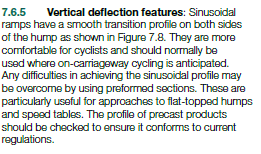
Therefore the decision to install speed humps which make it difficult to drive above the current 20mph speed limit are very welcome. However, we would ask the Authority to consider using sinusoidal speed humps rather than round top speed humps. This would be in line with the guidance in LTN 1/20 which states:
‘Sinusoidal ramps have a smooth transition profile on both sides of the hump as shown in Figure 7.8. They are more comfortable for cyclists and should normally be used where on-carriageway cycling is anticipated’. (LTN 1/20 7.6.5 p81)
The Green/St Marys Avenue
We support the proposal to install traffic calming measures on these roads but think that installing sinusoidal speed humps might be a better solution.
LTN has the following to say in regard to speed cushions ‘7.6.8 Speed cushions are a form of road hump and are therefore subject to The Highways (Road Hump) Regulations 1999. The dimensions allow wide tracked vehicles such as buses, ambulances and HGVs to straddle them. Cushions are not a preferred form of traffic calming on cycle routes because they constrain the ability of cyclists to choose their preferred position in the carriageway and are particularly hazardous to riders of three wheeled cycles.’ [This includes hand cycles and recumbent tricycles, which can tip over – both used by riders with disabilities. We would also add cargo bikes]
Arguably The Green/St Marys Road is not a ‘cycling route’ but the road is certainly used by cyclists and there is a specific reason why we think that speed cushions are not suitable here.
LTN para 7.2.1 reads
‘In normal traffic conditions, cyclists using the carriageway are advised to ride approximately 0.5m from the nearside kerb, to enable them to avoid gully grates’ (LTN 1/20 7.2.1 p74).
Further LTN 1/20 provides a table of minimum overtaking differences. It defines the kinetic envelope as follows
This gives a typical space profile of around 1.0m for a moving cyclist on a standard bicycle (dynamic kinetic envelope
(LTN 1/20 5.2.1 p40). As drivers approach a speed cushion they always look to straddle the cushion and will change their line if necessary. If the cushion is too near the kerb it means the drivers end up making a close pass of a cyclist – which is intimidating and hazardous. (See below)
So if a cushion is placed too near the kerb, cyclists will be subject to close overtaking. To avoid this and to comply with LTN 1/20 guidance the gap between the kerb and the edge of the cushion edge would need to be in the order of 2.5m to 3m. In fact this is exactly the arrangement on Forest View Road in Manor Park (see photos).
So if a cushion is placed too near the kerb, cyclists will be subject to close overtaking. To avoid this and to comply with LTN 1/20 guidance the gap between the kerb and the edge of the cushion edge would need to be in the order of 2.5m to 3m. In fact this is exactly the arrangement on Forest View Road in Manor Park (see photos).
But whilst Forest View Road is 10.5m wide St Marys Avenue is just 6.6m wide and so cannot accommodate this arrangement. This means that installing speed cushions in St Marys Avenue will expose cyclists to dangerous and intimidating close passes and that the scheme, as proposed, is not consistent with guidance found in LTN 1/20.
Hence our ask that sinusoidal speed humps are used.
Nightingale Lane
This looks a very good idea. Could cyclists be exempted from the ‘no right turn’ from Wellesley Road into Nightingale Lane?
High Street, Wanstead
This is very welcome and will help connect the two sides of the High Street. Installing speed tables help indicate to drivers that pedestrians have priority here and this will improve driver awareness this in turn should improve road safety.
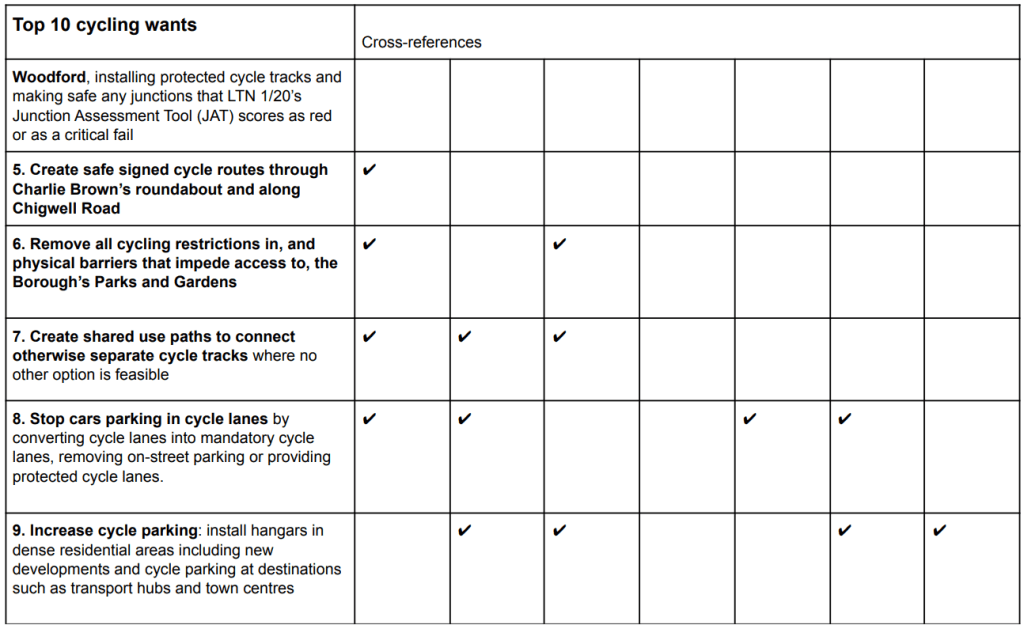
The process RCC used to produce its ‘Top 10 cycling wants’ is as follows. The group:
Pooled its knowledge of cycling in Redbridge (and other Boroughs).
Looked at the Council’s Local Implementation Plan (LIP), Climate Change Action Plan and its plan for Low Emissions Neighbourhoods, to see what ambitions and commitments the Authority has made towards cycling .
Looked at TfLs Strategic Cycle Network and the Authority’s Local cycle network
The Crashmap and Cycledat websites to identify accident blackspots.
We compiled a ‘long list’ which we grouped under the following sets of headings
Safety improvements
Connectivity
Promoting cycling for all
Quality of provision
We then selected our top ten.
The list is biased towards schemes that can be costed and, we think, fall within the scope of the Mayors Transport Strategy and so should be able to attract funding, rather than including broader aspirations that are difficult to cost and that will take some years to realise (we think that there are more than enough of these in the LIP, Climate Action Plan etc.)
We gave priority to schemes that will make things safer for cyclists now. Not all these schemes will promote wider policy ambitions but we think the first priority must be to reduce deaths and injuries: in two or three years time we would hope the Top 10 wants might look quite different.
After the Top 10 Wants list there are some notes that set out our wider thoughts on how to increase cycling uptake in the Borough.
If new cycle infrastructure is going to be used and give value for money it needs to be well designed: we think it is important that all schemes try to meet in full the guidance given in LTN 1/20 – our understanding is that only schemes that meet thee standards will be funded in future.
On a slightly separate note we know that there are road schemes, for example, road safety improvement schemes, whose primary purpose will not be to promote cycling but which might nonetheless be able to do just that and we would welcome the chance to share thoughts on these schemes.
Cyclists are not a homogeneous group: there are sports cyclists, commuters, families who like to ride in a park, and those who make local journeys by bike, for example, trips to rail and tube stations, shops or schools. There are also cyclists who use ‘non-standard’ bikes, for example, cargo bikes, trikes (people with mobility or balance difficulties often use these) or tandems
Sports cyclists and those currently commuting by bike are likely to settle for quick routes through the Borough with protection at junctions and roundabouts where the majority of accidents happen. But lack of protected cycle tracks and/or segregation from motor traffic is known to put off potential cyclists. If the Authority is to meet the ambitions it sets out in its Climate Change Action Plan and other documents it must make cycling safer for all.
Potential cyclists need to be persuaded they will be safe (citation to be added to LTN1/20). A complete borough network of separated cycle paths is impossible and it is inevitable that cyclists will share roads with motor traffic. Once the Authority has dealt with its accident blackspots it should focus its efforts on developing infrastructure that will support local trips by bike. The idea of the twenty minute neighbourhood (https://www.sustrans.org.uk/our-blog/get-active/2020/in-your-community/what-is-a-20-minute-neighbourhood) is relevant here: with a bit of imagination Redbridge can be conceived of as a set of neighbourhoods with centres and services – shops, post offices, GPs, etc. and cycling infrastructure can be put in to provide safe pleasant cycling to and from the service centres.
To maximise the safety of cyclists and so the numbers cycling the Authority has to be prepared to take steps to reduce the volume of motorised traffic and the speed at which it can move.
The experience across London is that new cycling infrastructure is quickly used but, there is such a suppressed demand for travel by car that, in the short term, this may not lead to a reduction in the number of car journeys: as one person chooses to travel by bicycle and not by car, someone else may be ready to step in and take that vacated road space. The strategy needs to be this: over the next two to three years, create a good quality network of connected safe cycle routes and then to introduce measures to reduce car journeys knowing that residents can choose to travel by bike because the routes are there and they are safe.
Some things we hope won’t get overlooked when designing schemes
Safety: Not only must cycle infrastructure be safe it must be perceived to be safe by potential users: an unsafe section, for example, a difficult junction that is left because it is difficult to sort out, may well mean that an otherwise good route is not used.
Connectivity:
“Cycle infrastructure must join together, or join other facilities together by taking a holistic, connected network approach which recognises the importance of nodes, links and areas that are good for cycling.”
(LTN 1/20 1.6.1)
No one would design a road from A to B with a section in the middle that is unsuitable for motor vehicles. The same should apply to cycle routes: cycle infrastructure must create safe continuous cycle routes to places that residents will want to go. Infrastructure that is isolated and which returns cyclists to hostile conditions is useless and will be a waste of money. The Authority could introduce, where necessary, and where no better alternative can be found, shared-use paths. At the moment there are signs across the borough that say ‘No cycling allowed’ where many cyclists will feel that there is no safe alternatives but to go on the pavement.
Promoting cycling for all: A design that might be suitable for a fit person on a solo bike may not be manageable for older riders, those using ‘non-standard’ bikes (which will include cyclists with disabilities, parents, and delivery riders). It is also important to provide residents with ways to get started with cycling and to remove hurdles to them choosing cycling.
Quality and quantity: If schemes are designed to the standards set out in LTN 1/20 (probably necessary in the future ay to secure funding) then they will be of good quality and will be much more likely to be used and so contribute to the Authority and the Mayor meeting their targets and aspirations.
Safety: Introduce a Borough-wide 20mph speed limit
The most compelling reason for introducing a 20mph speed limit is that pedestrians and cyclists who are hit at 20mph are much less likely to suffer serious injury or be killed than if hit at 30 mph. This ought to be enough reason but for many, it is not, so it is worth looking at the real impact on journey times by car at different speeds. A 5 mile journey made at 20 mph will take 15 minutes, the same journey made at 30 mph will take 10 minutes, a saving of 5 minutes. But anyone who uses Google or Waze will know that it is impossible to complete journeys in London at an average speed of 30 mph – even achieving an average of 20 mph is often impossible: stopping at traffic lights, pedestrian crossings and congestion all put paid to this. And then there are the ‘fixed’ times associated with a journey completed at any speed: embarking and disembarking, finding a parking space at the destination and walking from the car to the shops or wherever. In short, reducing the speed limit from 30 to 20 mph will make little real difference to motorists but will mean less cyclists and pedestrians are killed or seriously injured. Cycling in 20mph zones not only is but feels, safer, so residents are more likely to choose cycling for local journeys. Those who advocate 30 mph as the default speed limit are, in effect arguing that the greater risk to pedestrians and cyclists of death and serious injury is an acceptable cost for their freedom to travel – albeit briefly – at this speed. This cannot be right.
Supports
The Borough’s Climate Change Action Plan
The Borough’s Plans for Low Emission Neighbourhoods
Healthy Streets Scorecard
Safety: Dangerous Junctions and accident blackspots
The LCC has noted that, across London, too many schemes have been implemented that have left dangerous junctions in place or at best partially improved: one arm, one turning movement, one part of a junction, but not the whole thing. But ss LTN 1/20 puts it
‘Junctions and crossings are where most conflicts occur, and the actual and perceived hazards are greatest. Junctions are often the most hazardous and intimidating parts of a journey for cyclists. A junction that does not provide safe facilities may prevent people from cycling through the junction, but may also be the reason that people will not use the remainder of a route’
In order to make junctions far safer, what is needed is to build junctions that separate those cycling and walking from turning drivers – drivers shouldn’t be turning left across cyclists going ahead, and pedestrians need green person signals on all arms to cross safely. On top of that, we need to give more time on signals to walking and cycling – we know those walking and cycling largely don’t wait for minutes at a junction before they move – so we need to cut wait times and ensure enough capacity for those modes. We also need to build junctions, including side road turnings, for calm interactions – the Dutch build roundabouts for slow movement and good sightlines, on ours we splay entry and exit arms so drivers can move on and off faster.
Steps to make junctions safer:
Bike boxes/Advanced stop lines at junctions across the Borough with the approach to lights separated from the main traffic
Introduce a separate Green Phase for cyclists at traffic lights.
Supports
The Borough’s Climate Change Action Plan
TFL Strategic Cycle Network
The Borough’s Plans for Low Emission Neighbourhoods
Healthy Streets Scorecard
Safety: Create protected cycle lanes
Research [citation required] has found that those new to cycling are encouraged by protected cycle lanes. In the first instance, these should be introduced on roads used by cyclists that are excepted from the 20mph speed limit.
Supports
The Borough’s Climate Change Action Plan
TFL Strategic Cycle Network
The Borough’s Plans for Low Emission Neighbourhoods
Healthy Streets Scorecard
Safety: Stop parking in cycle lanes
Cars parked in cycle lanes force cyclists to move into the carriageway and into traffic. This is a dangerous manoeuvre. The Authority could consider, wherever possible, introducing parking restrictions along roads with cycle lanes or providing protected cycle lanes.
Supports
The Borough’s Climate Change Action Plan
TFL Strategic Cycle Network
Safety: Reduce traffic volumes
Residents are going to choose to make local journeys by bike if driving is a worse option and the Council must be prepared to make this happen by stopping rat-running across the Borough and reducing parking in neighbourhood centres, otherwise residents, whilst broadly being in favour of cycling, will find a reason why they should travel to a centre by car.
Supports
The Borough’s Climate Change Action Plan
The Borough’s Plans for Low Emission Neighbourhoods
Healthy Streets Scorecard
Promoting cycling for all: Allow cycling in all parks and remove barriers at entries and exits to parks
This is a quick win. Removing all cycling restrictions and barriers in the Borough’s Parks and Gardens will encourage beginners and family leisure cycling and some of these riders will go on to choose to cycle to the shop and so on. It will also promote a healthy lifestyle. And parks can connect up otherwise discrete pieces of cycle infrastructure – or at least shorten ‘missing links’. Other Borough’s do it so why not Redbridge?
Supports
The Borough’s Climate Change Action Plan
Promoting Cycling for all: Continue to install cycle hangers in high-density housing areas
Bike storage is a real problem for flat dwellers. Only the keenest will lug their bikes up and down buildings. If not already the case, can installing cycle hangers be made a de facto requirement for new developments under the auspices of planning gain?
Supports
The Borough’s Climate Change Action Plan
The Borough’s Plans for Low Emission Neighbourhoods
Healthy Streets Scorecard
Specific schemes
Safety: Introduce a Borough-wide 20mph speed limit:
Decide on which roads should be exempted from a 20mph speed limit. When these exempted roads are part of the strategic or local cycle routes through the Borough, introduce protected cycle tracks using KSI data to establish an order of priority. On roads for which a 20mph speed limit is imposed install cameras to enforce the limit or make changes to the road (speed humps, chicanes, etc.) to make 20mph the safe maximum speed. Work can be prioritised by first selecting those roads that are strategic or local cycling routes and then ordering these by KSI and similar data.
Safety: Dangerous Junctions and accident blackspots need to cross-reference list with Borough cycle route network
The blackspots have been identified from the Bike Data page on the CycleStreets and Crashmap websites are:
A118 Ilford Hill
A118 from Ilford High Road to Chadwell Heath (Strategic Cycle Network)
A1199 Holy bush Hill, Woodford High Road TFL (Strategic Cycle Network)
A104 High Road Woodford Green (Strategic cycle Network/LBR Local cycle network)
Ley Street LBR (Local cycle network)
Charlie Brown’s roundabout: in particular create useable high quality safe passages through the roundabout. Cyclists using the present routes have to dismount and cross the roads as pedestrians and cycle on pavements.
Safety: Install protected cycle lanes
Cranbrook Road from Gants Hill to Ilford
A118 from Ilford to Romford
Ley Street
Other streets?
Safety: Stop parking in cycle lanes
Roads such as Fencepiece Road
Promoting Cycling for all: Allow cycling in all parks
Claybury
Clayhall Park: remove barriers that prevent solo bikes with panniers, tandems, and family cargo bikes from accessing the cycle route
Other specific parks?
Connectivity: Ensure that cycle infrastructure is introduced to create continuous cycle routes
Allow shared usage along Eastern Avenue from Gants Hill towards Newbury Park
Allow shared usage on the footpath between High Road Woodford and Grove Road
Create a safe route through the mini-roundabouts at the junction of Aldersbrook Road, Lakehouse Road, Blake Hall Road and Centre Road to connect the new protected cycle lanes along these roads.
Ensure advanced stop lines or continuous cycle lanes at the Blake Hall Road, Bush Road, Overton drive junction.
We welcome input and feedback on these proposed 10 items from our members and cycling community.Please send us a message or email to let us know what you think.





 Redbridge Cycling Campaign